Luck & meaning
The flowerhorn in feng shui
Few pets arrive with as much meaning attached. To many families the flowerhorn is a living charm for longevity, prosperity and protection.
Why fish, and why water
Feng shui, the Chinese practice of arranging surroundings to encourage the good flow of energy, or qi, has long associated water with wealth. Moving, clean water is thought to gather and circulate good energy, which is why aquariums and fountains are fixtures in homes, shops and restaurants across Asia.
Fish carry their own meaning through language. In Chinese, the word for fish, 魚 (yú), sounds the same as 餘 (yú), meaning surplus or abundance. That is why “may there be abundance every year” is a New Year greeting and why fish appear on so much celebratory art. A healthy fish in clean water is abundance you can see.
For decades the arowana, the “dragon fish,” was the ultimate lucky fish. The flowerhorn arrived in the 1990s as a new contender, and quickly became a rival.
The kok and the God of Longevity
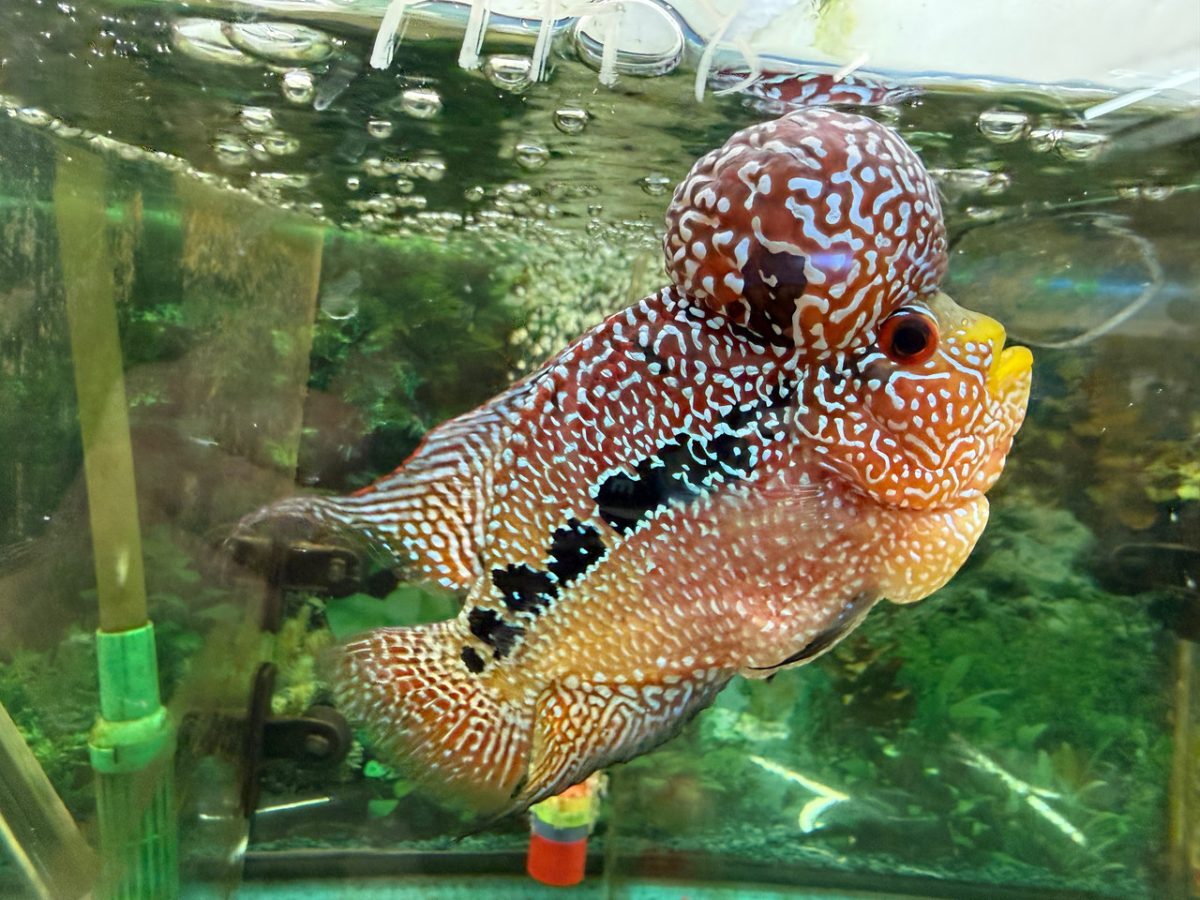
The flowerhorn’s most important feature, in feng shui terms, is the hump on its head. It is hard to miss the resemblance to Shou Xing (壽星), the God of Longevity and one of the three star gods of Chinese folk religion. He is almost always pictured as a smiling old man with an enormous, domed forehead.
A flowerhorn with a big, round kok therefore suggests long life and good health for the household. Traditionally, the larger and better formed the kok, the more auspicious the fish. This is a big reason why head size, above almost everything else, drives the value of a flowerhorn.
Markings that spell out fortune
The black blotches along a flowerhorn’s side are called its flower, and no two fish have the same pattern. Owners have long searched them for meaning. Some see Chinese characters, such as 福 (fortune) or 壽 (longevity). Others see numbers.
The numbers are where the legend took off. During the craze of the late 1990s and early 2000s, stories spread across Malaysia and Singapore of owners who read lottery numbers in their fish’s markings and won. Those stories helped push prices for “lucky” fish into the tens of thousands of dollars. A flowerhorn whose markings clearly form an auspicious character still commands a premium today.
One detail keeps the tradition interesting: markings change as a fish grows and as its mood shifts. Some owners take that as a sign the fish’s message is still being written.
What the colors mean
| Color | Traditional association | Strains known for it |
|---|---|---|
| Red | Luck, joy, vitality and protection. The color of celebration. | Red Dragon, Super Red Dragon, Kamfa |
| Gold & yellow | Wealth and prosperity | Golden Base, Golden Monkey |
| Pearling | Sparkle read as scattered coins or jewels, which means abundance | Zhen Zhu, Kamfa |
| Silver & white | Metal element, clarity | Thai Silk |
Where to place a flowerhorn tank
Feng shui practitioners don’t agree on a single rule, and many base their advice on a specific home’s layout and the owner’s birth chart. A few ideas come up often:
- Direction: the north, associated with water and career, and the southeast, associated with wealth, are the areas most often recommended. Some practitioners who follow the Flying Star school instead choose a spot based on the current period.
- The entrance or living room: a tank near the main living space is thought to welcome prosperity into the home. Many advisors avoid bedrooms and kitchens, where water is said to clash with rest or with fire.
- A single fish: since a flowerhorn is kept alone, it is often described as a guardian presence, one strong fish holding its own territory.
- Clean water above all: dirty or stagnant water is thought to bring stagnant energy. Every tradition agrees here, and so does every fish keeper.
If placement matters to you, a consultant can advise for your own home. For the fish, the practical rules are simple: a sturdy stand, away from direct sun and heating vents, somewhere it can see people going about their day.
Stories and the other side of superstition
Flowerhorn owners tell a particular kind of story. A fish dies suddenly on the same day a family member walks away from a car accident, and the family believes the fish took the misfortune in their place. Similar stories are told about arowanas, and they are part of why many owners treat their fish with real devotion.
Superstition cut the other way too. During the boom, fish whose markings didn’t deliver were neglected or discarded, and some people released fish into rivers and ponds to rid themselves of bad luck. Those fish are now an invasive problem in parts of Southeast Asia. Whatever a flowerhorn means to you, it is a living animal that can share your home for over a decade, and the luckiest fish is a well-kept one.
Questions about flowerhorn feng shui
Is a flowerhorn good luck?
In Chinese feng shui tradition, yes. Its kok resembles the forehead of Shou Xing, the God of Longevity, its red and gold colors represent luck and wealth, and its markings are sometimes read as auspicious characters or numbers.
Where should I put a flowerhorn for good feng shui?
The north and southeast areas of a home, or the main living room, are the placements recommended most often. Practitioners differ, so for a specific home a consultant is the best guide. Whatever the direction, keep the water clean.
What do the markings on a flowerhorn mean?
The black markings, called the flower, are unique to each fish. Some owners read Chinese characters in them, such as fortune or longevity, and during the flowerhorn craze many people looked for lottery numbers. The markings change as the fish grows.
Is a flowerhorn or an arowana better for feng shui?
Both are considered powerful. The arowana, or dragon fish, is the older symbol of wealth and power. The flowerhorn is associated especially with longevity and good fortune, and it is more affordable and easier to house than a large arowana.
Sources
- How the flowerhorn came to be the feng shui fish, FengShuied
- Flowerhorn aka Luo Han, Tian Lu Feng Shui
- Sanxing (deities), Wikipedia
- Craze for ornamental fish unleashes ‘killer’ in Malaysian waters, ThingsAsian
- Fancying the Flowerhorn, Animal Scene