Luck and meaning
Where to put a flowerhorn tank
Feng shui has a lot to say about where a fish tank belongs. So does a 14 inch cichlid that needs 75 gallons and stable heat. Here is how to satisfy both, and which one wins when they disagree.
The spots practitioners recommend
Our guide to the flowerhorn in feng shui covers why this fish carries so much meaning. This page is about the part that becomes a decision at home: which wall the tank goes on.
Feng shui writing about aquariums is specific about direction and less unified than it looks. The placements named most often:
- North. The water sector, linked with career, so a tank there is said to support work and income.
- Southeast. Usually named as the wealth sector. Its element is wood, and water is said to nourish wood, so some writers pair a southeast tank with plants. The east, also wood, is the common third choice.
- The bright wealth corner (明財位). Taiwanese and Hong Kong sources often skip the compass and point to the living room corner diagonally opposite the main door, as long as it is solid and not a walkway.
- The entry hall (玄關) or living room. Water near where people come and go is thought to welcome prosperity in, and the living room is where energy is said to gather.
Then the disagreements start. Some practitioners warn that a tank in line with the front door (正對大門) lets money run straight out again, while others call the entrance the strongest spot in the house. Flying Star practitioners (玄空飛星) ignore generic directions and read the chart of your building, and some Hong Kong practitioners favor water in the north in the current period nine (九運, 2024 to 2043). An older school puts water in the 零神 sector, the weak one rather than the auspicious one, contradicting the wealth-corner advice outright.
None of these directions is bad for a flowerhorn, and a compass sector covers a wide slice of a house, so there is nearly always a spot inside the recommended one that also suits a heavy tank.
The spots that get ruled out
The prohibitions are more consistent across schools than the recommendations, and many have a practical twin.
| Spot | What practitioners say | What the fish and the gear say |
|---|---|---|
| Bedroom | Too much water and yin energy in the room meant for rest. | Heaters, a canister and an air pump are not quiet at 3 a.m., and the fish bangs the glass for food. |
| Kitchen | Water against the fire of the stove, the clash called 水火相沖. | Cooking aerosols settle on the surface, oven heat swings the temperature, sprays drift into the lid. |
| Behind the sofa | Seats want a solid wall behind them, not unstable water. | The worst maintenance position in the house, and you never see the fish from your own seat. |
| Under a beam or low cabinet | Weight pressing down is read as suppressing the tank’s benefit. | You cannot lift the lid, net the fish or drop a hose in. |
A tank in line with the front door is disputed: many say fortune runs out through it, others call the entrance the best placement. Either way a doorway brings drafts and a slamming door next to a fish that jumps. Two taboos have no fishkeeping equivalent: the center of the home, where water is said to unsettle the earth element, and any spot under a shrine, described as 正神下水. The bedroom and the kitchen we would argue against even if feng shui said nothing, because they are where people most often try to squeeze a big tank.
Lucky numbers, and a fish that lives alone
Numbers are where the two sets of advice collide hardest. The counts most often called auspicious are one, six, eight and nine, and the best known formula is nine fish: eight gold or red plus one black, a yang and yin balance. Four is widely avoided because 四 sounds like 死. Past that the lists diverge: some assign a number by the owner’s zodiac sign and element, others call every odd number lucky, and one names seven unlucky where another calls it fine.
A flowerhorn is kept one to a tank. It was bred from some of the most territorial cichlids in the hobby, and a second fish usually ends in torn fins, a lost eye or a dead fish, as our guide to flowerhorn tank mates explains. A divider is a management tool, not a loophole: few practitioners would count two fish that cannot reach each other as a pair of anything.
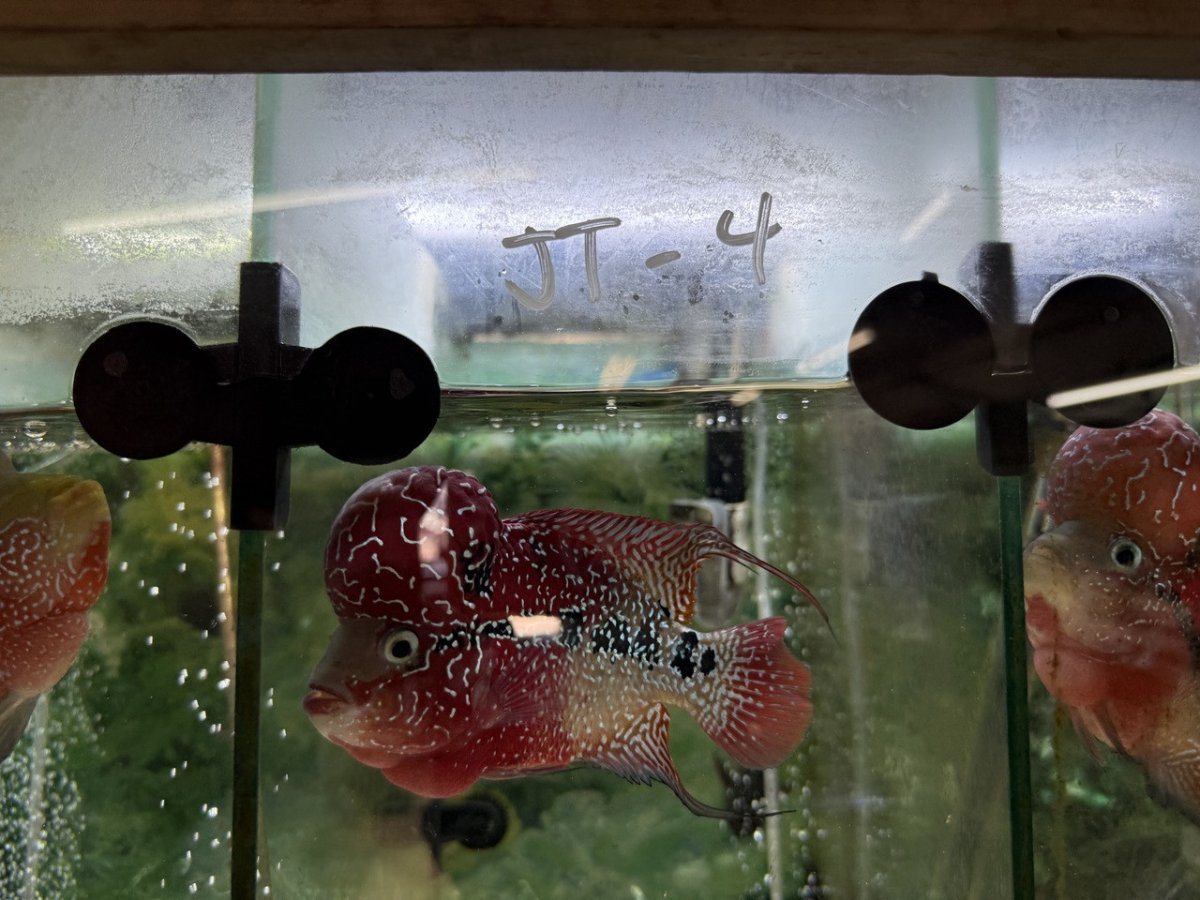
Owners square it three ways. One fish is an auspicious count on most lists. The flowerhorn is commonly described as a guardian rather than a school, one strong fish holding its territory, which fits the animal. And keepers who want nine keep nine of something else in another room. What nobody should do is add fish to a flowerhorn tank to hit a number.
A related rule in Chinese sources says to choose calm ornamental fish and avoid fighting species. By that rule the flowerhorn fails outright, and owners who keep one are weighing the kok and its link to longevity above the temperament rule.
Shape, size and height
On shape, tradition and fishkeeping nearly agree. Rectangular tanks are called stable and auspicious, round ones belong to water, and triangular or irregular tanks are discouraged because the triangle belongs to fire. A flowerhorn wants what the rectangle gives it: length and front-to-back depth to turn in. Corner and bowfront tanks waste swimming length.
On size, feng shui asks for proportion, and several writers add a height rule: the water should not sit above the standing owner’s heart, chest or eye level, depending on the source. The fish has its own floor. Plan on 75 gallons (284 L) for one adult and 90 to 125 gallons (340 to 473 L) for a big male, in the standard 48 by 18 inch (122 by 46 cm) footprint or larger. On a 30 inch stand, the water in a 75 sits around chest height on most adults, inside the traditional range without anyone trying.
Weight is the part neither tradition mentions. A filled 75 gallon setup is commonly estimated at roughly 800 pounds (360 kg), so put it against a load-bearing wall, across the joists rather than along one. Our tank setup guide covers stands, filtration and lids.
To size the tank, filter and heaters for your own fish, run the numbers through the tank and equipment calculator.
The one thing both traditions agree on
Every source we read, in English and in Chinese, says the same thing about water quality, usually more emphatically than anything about direction. Cloudy, green or smelly water is read as stagnant energy, and a neglected tank as worse than no tank. Several add that aeration and regular changes keep the energy moving.
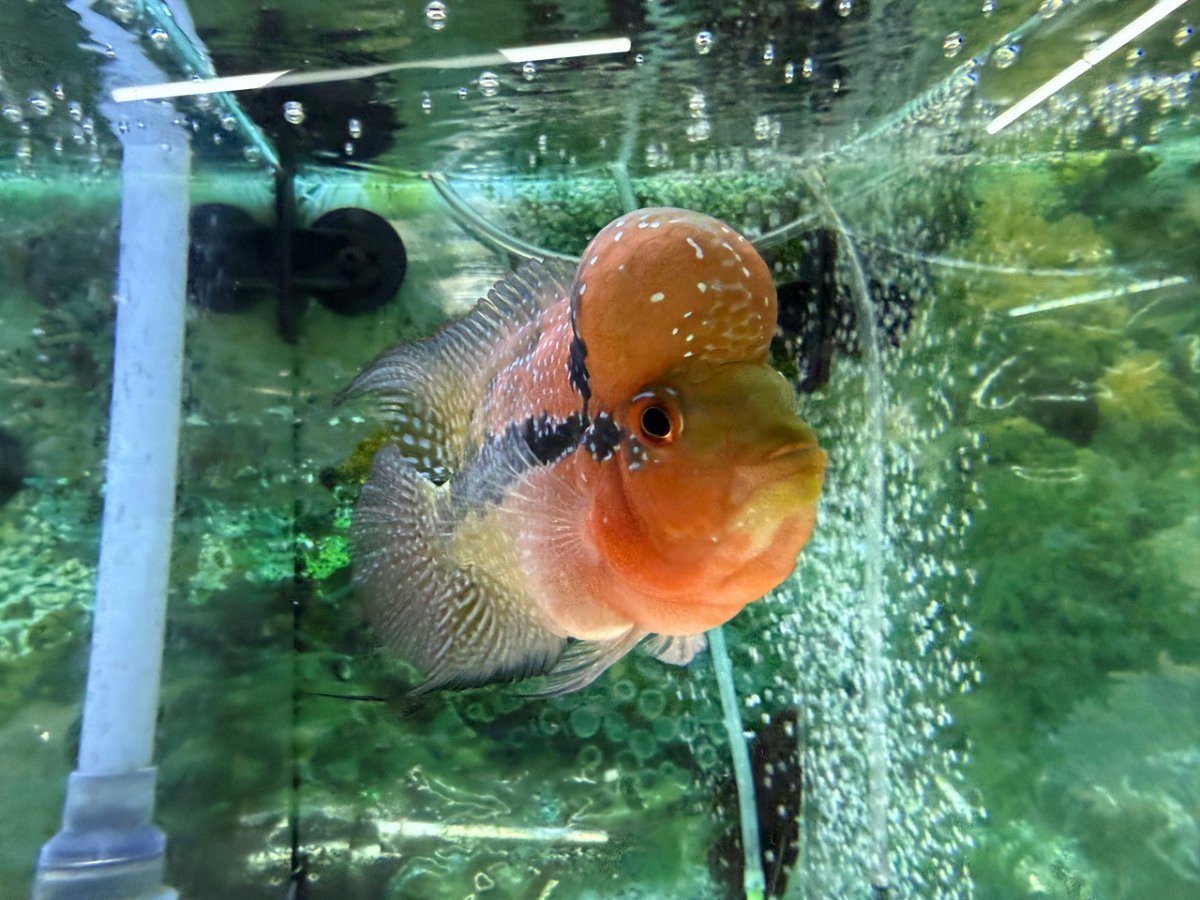
Fishkeeping says it differently: change 25 to 30 percent weekly, filter at five to ten times the tank volume per hour, hold 80 to 86°F (27 to 30°C), test rather than guess, and feed less than the fish begs for. The water and temperature guide has the routine.
One belief is worth translating carefully. Some writers say that if fish keep dying in a spot, the spot is unlucky and the tank should move. In our experience repeated losses trace to something measurable: a failing heater, an afternoon sun patch, a vent on the glass, or an untreated illness covered on our page about flowerhorn diseases. Moving the tank is sometimes right, but for a reason a thermometer can find.
When the two sets of rules disagree
Our position: the fish’s requirements are fixed and the feng shui advice is adjustable. A placement that shortens the life of a fish you will keep for a decade is not a lucky one by anyone’s reading. Common collisions:
- The recommended sector is a sunny window. Direct sun means algae and daily temperature swings. Shift along the same wall out of the sun patch, or fit a blind.
- The wealth corner is upstairs on a weak span. Weight wins. Find a spot in that sector over a load-bearing wall, or keep the flowerhorn downstairs.
- The entry hall is a narrow walkway. A tank you cannot open or reach behind will not get maintained.
- The number says nine. One flowerhorn. Keep the nine somewhere else.
Most conflicts are smaller than they look. Moving a tank three feet along the same wall usually keeps a practitioner happy while solving the sun, the floor or the outlet. If a consultant is working from your floor plan, tell them the tank weighs as much as a piano and needs power and clearance. They will work with that.
A checklist for a spot that satisfies both
Walk the room with this before you buy anything. Every item serves the fish, and none contradicts mainstream feng shui advice.
- Solid, level floor. Load-bearing wall, joists crossed rather than followed, ground floor if possible. Shim the stand, never the glass.
- No direct sun. Watch the wall through a full afternoon first. Sun patches move.
- Away from vents, radiators and fireplaces. Forced air on glass swings temperature more than people expect.
- Visible from where people sit. A flowerhorn that watches the room becomes the pet described in the flowerhorn as a pet. A fish in a corridor gets ignored, and both traditions treat a cared-for tank as the whole point.
- Power within reach. A dedicated outlet, ideally GFCI protected, with drip loops on every cord and no daisy-chained extension leads.
- Clearance above and behind. Room to lift the lid, net the fish and reach filter hoses without moving furniture.
- Off the traffic path. Not in a doorway, not where a door swings, not against a subwoofer wall.
- A sane route for water. A tank two rooms from a tap gets cleaned less often.
- Then the overlay. Out of the bedroom and kitchen, ideally the living room or the wealth corner, cords hidden, water clear.
If the best feng shui spot and the best fish spot are not the same, take the fish spot and keep the tank spotless.
Questions about flowerhorn tank placement
Which direction should a flowerhorn tank face for good feng shui?
North, southeast and east are recommended most often, along with the living room and the corner diagonally opposite the main door. Schools disagree, and Flying Star practitioners read the building’s chart instead. No direction harms the fish, so choose within the sector using sun, floor strength and outlets.
Can I keep a flowerhorn tank in the bedroom?
Most practitioners advise against it, and so do we. A 75 gallon setup runs filters, heaters and pumps around the clock, adds humidity, and puts a lit tank in the room where you want dark and quiet.
How many flowerhorns should I keep for luck?
One. Auspicious counts such as eight or nine belong to community fish like goldfish and koi. A flowerhorn is territorial and kept alone, and one is an auspicious number on most lists anyway.
Should the tank face the front door?
Sources conflict. Some treat the entrance as the best place for water, others warn that a tank in line with the door lets fortune flow out. A doorway also brings drafts and slams, so we would put the tank in the room rather than the entry.
Sources
- 2026 魚缸擺放全攻略:客廳、財位禁忌與招財方位解析 (Fish tank placement guide), Rakuya
- 魚缸要擺在兇位!6種風水禁忌曝光 (Six fish tank feng shui taboos), ETtoday
- 風水魚缸怎麼擺? (How to place a feng shui fish tank), NOWnews
- 養魚風水|必知7大養魚風水禁忌 (Seven taboos of keeping fish), Cosmopolitan Hong Kong
- Feng Shui Aquariums: Guidelines for Wealth, Red Lotus Letter
- Preparing Your Home for a New Fish Tank, Aqueon