Origins & history
Where the flowerhorn came from
The flowerhorn is younger than most of the people who keep it. It was built in a single generation of hobbyists, in Malaysia and Taiwan, from fish that never met in the wild.
A fish with no home river
Most aquarium fish have a wild address: a lake in Africa, a blackwater stream in the Amazon. The flowerhorn doesn't. Its ancestors come from Central America, its immediate parent from Taiwan, and the fish itself from breeders’ tanks in Malaysia. If you want to see a flowerhorn in its natural habitat, the honest answer is a living room.
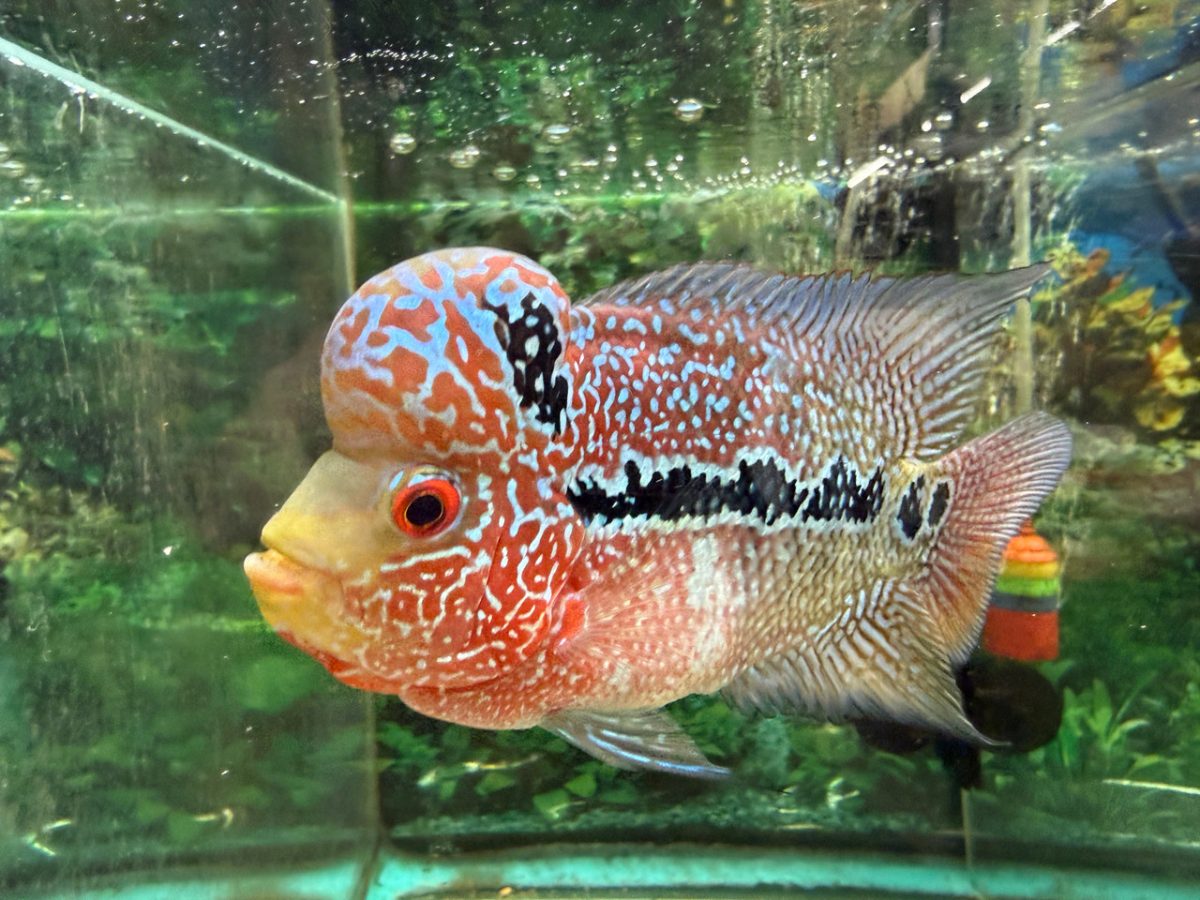
That makes its history unusually human. It is a story of taste, trade routes, superstition and money, and like most hobby history it was passed along by word of mouth long before anyone wrote it down. Dates vary by a year or two depending on who tells it. The shape of the story does not.
The blood parrot sets the stage
Before the flowerhorn there was the blood parrot cichlid, a hybrid developed by breeders in Taiwan in the 1980s. With its round body, beak-like mouth and bright orange color, the blood parrot proved something important: Asian buyers would pay well for a cichlid that nature never made, as long as it looked the part.
Through the late 1980s and early 1990s, Malaysian keepers were also falling for big Central American cichlids, especially fish with a pronounced hump on the forehead. In Chinese-speaking communities that hump already had a meaning. It looked like the tall, domed forehead of Shou Xing, the God of Longevity.
The first crosses in Malaysia
Breeders’ accounts place the first deliberate crosses around 1993 and 1994. By then red devil and trimac cichlids from Central America were being imported into Malaysia, and blood parrots were arriving from Taiwan. Hobbyists began crossing them to see what would come out.
Some of the early results sold under names like the “Five Colors God of Fortune.” Over the next few years breeders crossed those offspring back with other big cichlids and kept the fish that had the biggest heads, the strongest markings and the brightest color. By around 1998 a recognizable type had emerged, and it had a name: 花羅漢, huā luóhàn, the flower luohan.
Which fish went into the flowerhorn?
Nobody published a recipe. Breeders guarded their lines, crossed and re-crossed freely, and rarely kept records. What we have instead is a list of species that come up again and again in breeder accounts and reference sources, along with the traits each one is usually credited with.
| Commonly cited ancestor | Native to | What breeders credit it with |
|---|---|---|
| Red devil (Amphilophus labiatus) | Nicaraguan lakes | Size, red coloration, boldness |
| Trimac (Amphilophus trimaculatus) | Pacific slope of Mexico & Central America | The black blotches that became the “flower” markings, and the head hump |
| Midas cichlid (Amphilophus citrinellus) | Nicaragua & Costa Rica | Gold and orange tones, a strong nuchal hump |
| Blood parrot (hybrid) | Bred in Taiwan | Color and a heavier, rounder body |
| Red terror or festae (Mesoheros festae) | Ecuador & Peru | Red and orange tones |
| Vieja cichlids, such as the redhead | Central America | Later lines, especially Kamfa: a square body, a hard round kok and heavy pearling |
Reference sources most often name the red devil and trimac as the core parents. The rest depend on the line. That is why two flowerhorns can look like different fish entirely, and why the hobby sorts them into strains rather than treating them as one breed. More on that in breeding & strains.
Timeline
- 1980sBreeders in Taiwan develop the blood parrot cichlid, proving there is a market for hybrid cichlids.
- 1993–94Malaysian hobbyists cross imported red devils and trimacs with blood parrots from Taiwan. Early offspring sell under names like “Five Colors God of Fortune.”
- c. 1998After repeated crosses and selection, a stable-looking type emerges and takes the name hua luo han.
- 1998–2002The boom. Flowerhorns spread through Malaysia, Singapore, Taiwan, Thailand and beyond. Prize fish change hands for the price of a car.
- c. 2000Flowerhorns reach the Philippines, then North America, where early imports sell mainly as “flowerhorn” and “golden base.”
- 2003Malaysian press reports top fish at 80,000 to 100,000 ringgit, with one owner hoping for 1.2 million, while unwanted fish are being dumped into drains, ponds and rice fields.
- 2000sAfter the crash, serious breeders in Malaysia and Thailand refine the lines that define the modern hobby: Kamfa, Zhen Zhu and Golden Base among them.
- 2009A Golden Monkey flowerhorn is reported sold for US$600,000 at a Malaysian exhibition, the most expensive on record.
- TodayA settled, worldwide hobby with dedicated breeders, shows and strains, and a pet valued as much for its personality as its luck.
Boom and bust
Between roughly 1998 and 2002 the flowerhorn became one of the great pet crazes in Asia. The fish was new, it was beautiful, and it came with a promise. Stories circulated of owners who read winning lottery numbers in the markings on their fish’s side. Prize fish sold for tens of thousands of dollars, and ordinary families bought fry for a few ringgit hoping to raise a winner.
Every craze needs supply, and breeders delivered. Fish that didn’t show good markings or a big kok were worth almost nothing, and there were millions of them. As prices fell and fashions moved on, many fish were simply let go. Some were dumped by breeders, some released by owners who had lost interest, and some released on purpose by people who believed that setting the fish free would carry their bad luck away.
The result is a lasting ecological problem. Flowerhorns now live wild in waterways in Malaysia and Singapore, where they are considered an invasive pest that competes with native fish. Australia bans their import. It is the part of the story every keeper should know, because the lesson still applies: never release an aquarium fish.
The flowerhorn today
The crash was good for the fish. With the speculators gone, the people left were the ones who liked flowerhorns for what they are, and they spent the 2000s and 2010s turning a messy hybrid into a set of recognizable strains. Thailand and Malaysia remain the centers of serious breeding, and top-grade fish still command high prices at shows.
In the United States the flowerhorn is now a fixture in specialty fish stores. Buyers tend to come from two directions: families who grew up with the fish as a symbol of luck, and keepers who have heard it is the closest thing the hobby has to a dog. Both are right. Read on for how flowerhorns are bred, what they mean in feng shui, and why they bond with people.
Questions about flowerhorn history
Where does the flowerhorn come from?
Malaysia. Breeders there developed the flowerhorn in the 1990s by crossing Central American cichlids, chiefly the red devil and trimac, with the blood parrot, a hybrid bred in Taiwan.
When was the flowerhorn created?
The first deliberate crosses are usually dated to 1993 or 1994, and the fish recognizable as a flowerhorn, named hua luo han, emerged around 1998.
What two fish make a flowerhorn?
There isn’t a single two-fish recipe. The red devil and trimac are the parents named most often, but blood parrots, Midas cichlids, festae and later Vieja cichlids were all used, and different strains carry different mixes.
Why are flowerhorns illegal in some places?
Because released flowerhorns have become invasive in parts of Southeast Asia. Australia bans their import. In the United States they are legal to keep in most places, but check your state and local rules, and never release one.
Sources
- Flowerhorn cichlid, Wikipedia
- Fancying the Flowerhorn, Animal Scene
- Craze for ornamental fish unleashes ‘killer’ in Malaysian waters, ThingsAsian (2003)
- The man who still rears his luohan fish, YP SG
- Flowerhorn cichlid hybrid, iNaturalist