FAQ
Flowerhorn questions and answers
The same questions come up at our counter every week. Here are the short answers, grouped by topic, each one pointing to the page that covers it in full.
How to use this page
We have sold and talked about flowerhorns in San Diego since 2007, and the questions barely change. How big does it get? Why is the head not growing? Can it live with anything? Is it really lucky? Here are the short answers.
In San Diego? See flowerhorns in San Diego for local water, climate and where to see them.
Every answer links to the guide that goes deeper. For the whole picture, start with the care guide, the strain guide, the buying guide or hybrid cichlids explained. Unfamiliar words are defined in the glossary.
The basics
What is a flowerhorn fish?
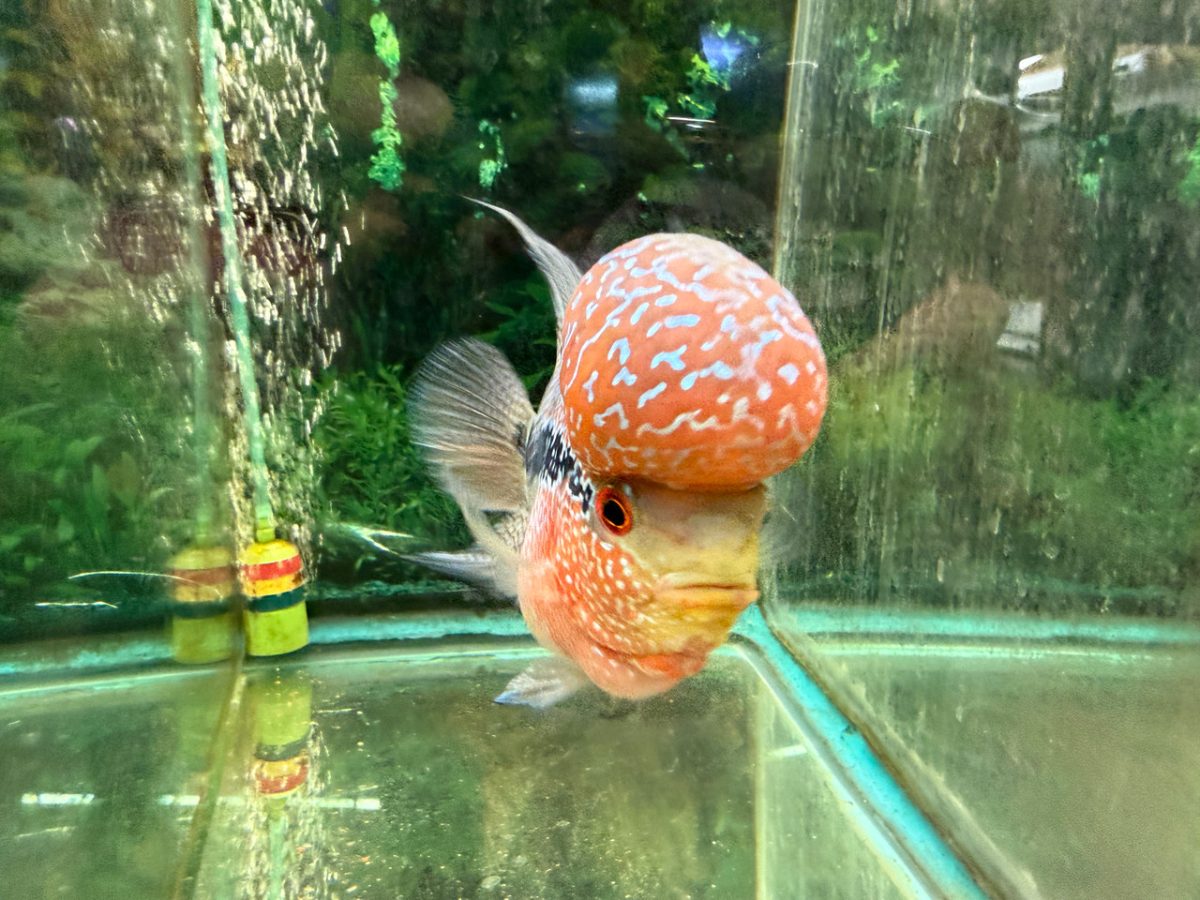
A flowerhorn is a man-made hybrid cichlid, bred in Malaysia in the 1990s from Central American cichlids such as the red devil and trimac crossed with the blood parrot. Breeders selected for three things: a domed forehead called the kok, bold black markings along the side, and color. The Chinese name is 花羅漢, huā luóhàn, often shortened to luohan. The full story is in where the flowerhorn came from.
Are flowerhorns a natural species?
No. There is no river anywhere that produced a flowerhorn, and no scientific name for it. The wild flowerhorns found in parts of Malaysia and Singapore came from fish that people released, which is one reason some countries ban them. See hybrid cichlids explained for the ethics argument around it.
How big do flowerhorns get?
Most well-kept flowerhorns finish between 12 and 16 inches (30 to 40 cm) in total length, and plenty of home-kept fish land nearer 10 to 12 inches. Males usually run an inch or two longer than females from the same spawn. Most fish are close to final length between 12 and 24 months. How big flowerhorns get has a growth chart by age.
How long do flowerhorns live?
The range cited most often is 8 to 12 years, and about 10 to 12 is realistic for a well-kept long-body fish. Short body types are generally given shorter estimates. Tank size, water quality and feeding do more to decide where a fish lands in that range than anything else. Read how long flowerhorns live.
Are flowerhorns aggressive?
Yes, and it gets stronger as they mature. A flowerhorn will claim the whole tank, charge the glass at people and equipment, and attack almost anything put in with it. That boldness is also why keepers love them. Flowerhorn behavior covers what the displays mean.
Can a flowerhorn live with other fish?
Usually not. One flowerhorn per tank is the rule, and a divider is the exception rather than a shared tank. A few experienced keepers manage large, robust tank mates in very big tanks, but injuries and losses are common and there is no reliable combination. Flowerhorn tank mates explains what fails and why.
Are flowerhorns good for beginners?
They are hardy and forgiving of small mistakes, which makes them friendlier than their reputation suggests. They are not low maintenance, though: a single adult needs at least 75 gallons, heavy filtration and weekly water changes for a decade. The care guide lays out the whole job.
Care
What size tank does a flowerhorn need?
At least 75 gallons (284 L) for one adult, and 90 to 125 gallons (340 to 473 L) for a large male. A juvenile can live in something smaller for a while, but buy for the adult fish, because a 3 inch juvenile can pass 10 inches within about a year. Our tank calculator turns a tank size into filter, heater and water change numbers, and tank setup covers the rest of the build.
What water temperature do flowerhorns need?
Between 80 and 86°F (27 to 30°C), with many keepers holding steady near 82°F (28°C). Stability matters as much as the exact number, so use a guarded heater plus a separate thermometer. A pH of about 7.0 to 8.0 in moderately hard water suits them. See water, temperature and the nitrogen cycle.
How often should I change my flowerhorn’s water?
Change 25 to 30 percent every week, siphoning waste off the bottom as you go. Heavily fed fish and smaller tanks need more, and the test kit is the real guide: ammonia and nitrite at zero, nitrate low. Skipped water changes are behind most of the health problems we see. Details in water and temperature.
What should I feed a flowerhorn, and how often?
A quality flowerhorn or cichlid pellet at roughly 40 to 50 percent protein is the staple, with frozen shrimp, krill or mysis a few times a week. Adults do well on one or two small meals a day, juveniles on two or three, and only what the fish clears in a minute or two. Skip feeder fish, which carry parasites and fat the fish does not need. Full detail in feeding a flowerhorn.
Why is my flowerhorn’s kok not growing?
Most often because the fish is young or because its genetics do not carry a big head. Koks usually start developing between 6 and 12 months and keep filling out into the second year, and some fish are simply late. No food, hormone or mirror adds a kok the fish was never going to grow; clean warm water, a good diet and low stress just let it reach its own potential. Read growing a flowerhorn kok.
Why did my flowerhorn’s color fade?
Fading almost always points to stress, poor water quality or a recent change such as shipping or a new tank. Test ammonia, nitrite and nitrate first, check the temperature, then give the fish a few quiet weeks. Color also shifts with age, mood and lighting, and Golden Base faders lose their black on purpose. See kok growth and Golden Base flowerhorns.
Why is my flowerhorn dark, hiding and not eating?
In a fish that just arrived, that is normal for the first few days. In a settled fish, treat it as a water quality problem until the tests say otherwise, then look for pitting on the head, clamped fins, cloudy eyes or a swollen belly. Flowerhorn diseases walks through the common ones, and shipping and acclimation covers the first two weeks.
Buying a flowerhorn
How much does a flowerhorn cost?
In Pet Zone’s own listings checked in September 2026, batch-sold fry ran roughly $30 to $95 depending on strain, size and seller, and individually photographed juveniles of about 4 to 6 inches ran $188 to $288. Prices move with size, strain, grade and shipping, and they change often. What a flowerhorn costs breaks down each factor.
How can I tell if a flowerhorn is male or female?
Visual clues start to mean something at around 4 inches or six months: males tend toward a larger kok, pointed fins and a thicker body, while black spots in the dorsal fin often suggest a female. None is decisive alone, and venting, the reliable method, needs a mature fish, often 8 months or older. Work through sexing a flowerhorn or use our male or female checker.
What makes a flowerhorn high quality?
A large, even kok, solid flower markings, dense bright pearling, deep color, and a body and fins true to its strain, all on a fish that is active and eating. Balance across all of those counts for more than one standout feature, and seller labels like AAA are marketing rather than a standard. Use how to judge flowerhorn quality, or score a fish out of 100 with the grading scorecard.
Is it safe to buy a flowerhorn online?
It is, from a seller who photographs each fish individually, ships overnight and publishes a written live arrival guarantee. Live fish should never travel by ground. Before you pay, ask what a dead-on-arrival claim requires from you. Shipping and acclimation covers delivery day, and our own fish are listed at flowerhorn.co.
What size flowerhorn should I buy first?
A 3 to 5 inch juvenile is the usual sweet spot: hardy enough to ship, already showing color, and far cheaper than an adult. Fry cost the least but are unsexed and unproven. A grown fish is exactly what you see and costs the most. Compare the stages in the buying guide.
Which flowerhorn strain should I get?
Kamfa for head and body shape, Zhen Zhu for heavy pearling and a firm kok, Red Dragon for solid red, Thai Silk for a metallic sheen, Golden Base for a hardy and affordable start. Short body types are popular but carry real health risks, so read up before choosing one. Start at the strain guide, and decode the tank labels with names and aliases or the page on short body flowerhorns.
Meaning and behavior
Are flowerhorns considered lucky?
In Chinese feng shui tradition, yes. The kok resembles the domed forehead of Shou Xing, the God of Longevity, red and gold are colors of fortune, and the black markings are sometimes read as auspicious characters or numbers. That belief is a large part of why the fish was bred in the first place. Read the flowerhorn in feng shui.
Where should I put a flowerhorn tank for good feng shui?
The north and southeast areas of a home, or the main living room, are the placements recommended most often. Practitioners disagree on the details, so a consultant is the best guide for a specific house. Whatever direction you choose, clean water and a healthy fish matter more than the compass. See flowerhorn tank placement.
Do flowerhorns recognize their owners?
Keepers say so almost universally: the fish greets one person at the glass, begs at feeding time and flares at strangers. Research has shown that at least some fish can tell human faces apart, and cichlids are among the most behaviorally complex fish in the hobby. More in the fish that acts like a dog.
Do flowerhorns get lonely on their own?
No. They are not schooling fish, and a solo flowerhorn is the normal, healthy way to keep one. Kept alone, they usually become more interactive with people, not less. If the tank looks empty to you, add more swimming space and something to rearrange rather than another fish. See tank mates.
Can you touch a flowerhorn?
Many will tolerate or even come up for a light touch on the head from someone they trust. Build to it slowly through hand feeding, wash and rinse your hands first, keep contact brief, and expect the occasional nip, because a big adult can draw blood. The flowerhorn as a pet covers building the bond.
Why do my flowerhorn’s markings keep changing?
Because they do. The flower line darkens, breaks up and reforms as a fish grows, and it also shifts with mood, spawning condition and stress within a single day. A pattern that looked like a character last month may not this month. How flowerhorns are bred explains how breeders grade those markings, and the glossary defines the terms.
If your question is not here
The hubs cover the rest: care for the day-to-day, strains for telling fish apart, buying for choosing one, and hybrid cichlids for the wider family, including the blood parrot that helped make the flowerhorn.
Four small calculators live in our tools section, including a growth tracker for logging length and kok over time.
In Southern California, bring your question or a water sample to Pet Zone in San Diego. More about who we are is on the about page.
Sources
- Flowerhorn Cichlid Care: Size, Life Span, Tank Mates, Breeding, FishLore
- Flowerhorn cichlid, Wikipedia
- Flower Power: Are Flowerhorns Good for the Hobby?, Tropical Fish Hobbyist Magazine
- Do FH’s get lonely?, Cichlid Forum
- How long do flowerhorns live?, MonsterFishKeepers
- Flowerhorns for sale (checked September 2026), Pet Zone Tropical Fish