Buying
How to judge flowerhorn quality
Breeders grade fry by the thousand. As a buyer you only have to grade one fish, but you need to know what you are looking at and which flaws actually matter.
Start with the whole fish
Our breeding page explains how breeders sort a spawn, and what they grade on at each age. This page is the buyer’s side: standing at a tank, or looking at a listing, and deciding whether a fish is worth its price.
Before zooming in on the head, step back. A good flowerhorn looks balanced: the kok suits the body, the markings run cleanly, the fins frame the fish, and nothing looks bent, pinched or ragged. One spectacular feature on a mismatched fish is worth less than a fish that is good everywhere.
Grade against the strain, too. A Thai Silk is judged mainly on its sheen, not its markings; a Kamfa is judged hard on head and body shape; a Zhen Zhu on pearling. The strain guide sets out what each line should look like.
The head: kok, eyes and mouth
Kok
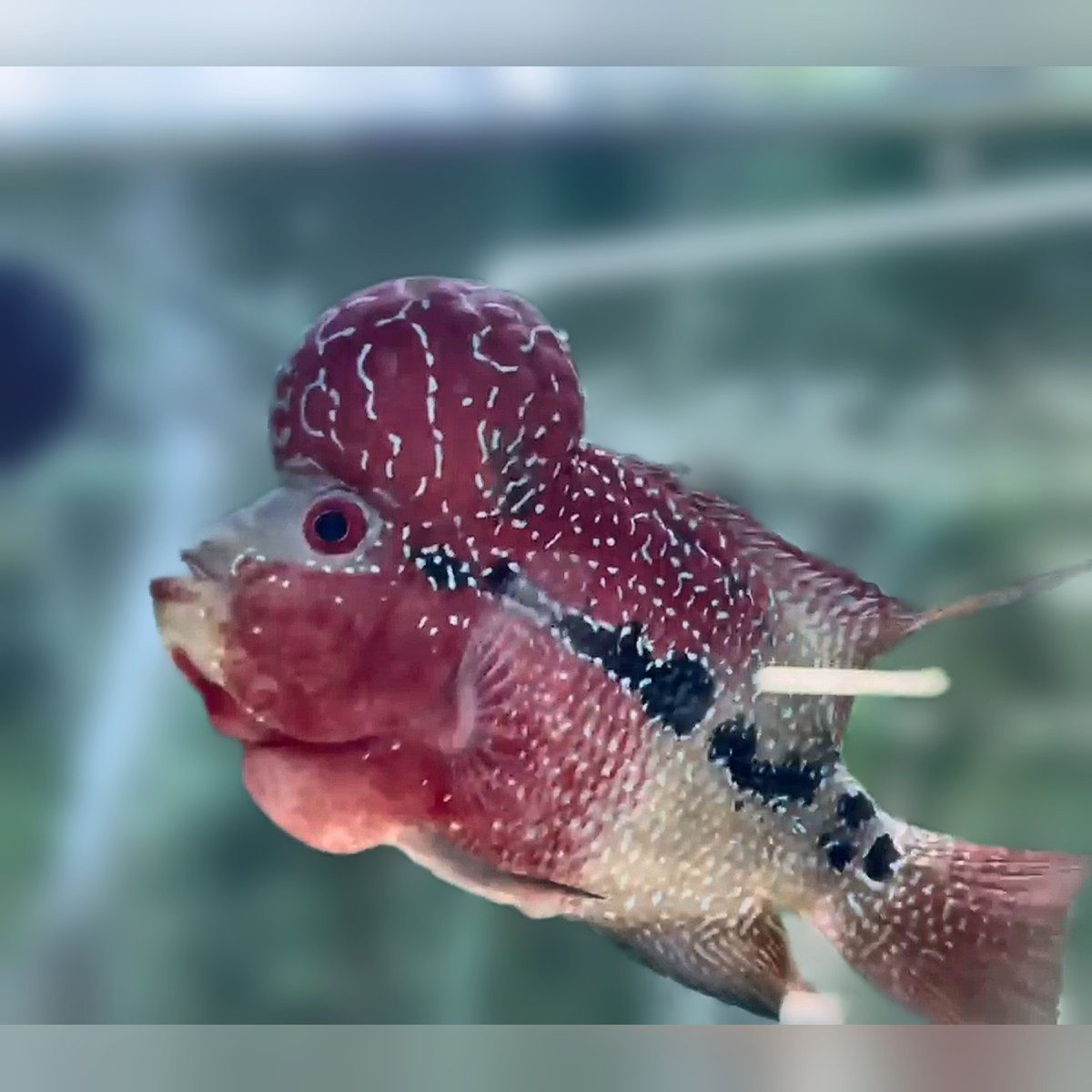
Size matters most, but shape comes close. Look for a full, rounded hump that sits evenly over the head when viewed straight on, without a lopsided bulge or a dent. In Kamfa lines the kok usually sits further forward than on a Zhen Zhu. Hobby graders distinguish a soft water kok (the largest, fluid-filled type) from a firm, smaller hard kok, with semi kok in between.
Remember that a kok changes. It can look bigger when the fish is excited or flaring and shrink with stress, shipping or poor water. Judge it on a relaxed fish, and read kok growth for how much care can add.
Eyes
Eyes should be clear, bright and matched in size and position. Cloudiness is a health problem, not a grade issue. Kamfa fish are prized for a sunken or hollow-looking eye, which comes in white, orange, yellow or red; on other strains a clean, vivid eye color adds to the look.
Mouth
The jaws should close evenly with the lips meeting cleanly. Kamfa graders look for smooth, rounded lips on a short face. A crooked jaw, a mouth that does not close, or a noticeable underbite are faults buyers commonly avoid, even on a pet.
Flower, pearls and color
Flower markings
The flower is the row of black blotches along the side, sometimes called the lateral line or script. Common grading guides rate darker, more solid and straighter markings higher, and broken or faint lines lower. Kamfa graders often look for markings that are 75 percent to fully solid black. Scriptless fish exist and are a taste, not a fault, as long as you are not paying for markings the fish does not have.
Pearling
Pearls should be bright, even and dense, ideally running over the face and kok and down the body into the fins. Patchy pearling, or pearls only on one side, lowers a fish. On a Zhen Zhu, pearling is a main event; on a Kamfa it is a bonus some buyers do not care about.
Color
Look for deep, even color with good coverage rather than a washed-out body with bright patches. Two cautions. Color shifts with mood, lighting and water, so judge in plain light on a settled fish. And color can be pushed with enhancing foods: a small juvenile that looks unusually saturated may fade, and hobby sources warn some fish darken for months if fed the wrong enhancer. The feeding guide covers color foods. Golden Base faders are a special case; you are buying the future color, not the present one.
Body, fins and tail
Viewed from the side, a quality body is thick and deep with a smooth top line from kok to tail. Kamfa should look square, stout and solid with a short face; Zhen Zhu is typically longer in the body. Short-body or balloon fish are their own category with health trade-offs (see short body flowerhorns).
Look along the spine for kinks, a sunken belly or a pinched area behind the head, which can signal poor condition. The body should not be noticeably thinner on one side than the other when the fish turns toward you.
Fins should be whole and held open. On a strong Kamfa the dorsal and anal fins wrap around the tail so the three read as one fan. The tail itself should be big and spread, not stretched thin, split or ragged. A little fin damage from netting or a store tank heals; a missing or deformed fin does not.
Posture and behavior
A quality flowerhorn is worth nothing if it is sick, and behavior is the fastest health check you have.
- Swimming level: the fish holds position easily, not tilted, head-down or struggling to stay off the bottom.
- Fins: held open, not clamped against the body.
- Engagement: comes to the glass, follows movement and flares at a hand.
- Appetite: ask to see it eat. A healthy flowerhorn rarely turns down food.
- Head and skin: no pits or holes on the head, white spots, cotton-like growths or red streaks in the fins. The diseases guide shows what these mean.
Some dark barring on a fish that has just been moved is normal. A fish that stays dark and hides in its home tank is a warning.
Pet grade vs show grade
There is no universal flowerhorn grading standard. Letter grades such as AAA, AA, A down to C are used by many sellers and hobby guides, but each seller applies them their own way, so a grade on one site does not translate to another. Judge the fish, not the label.
| Pet grade | Show grade | |
|---|---|---|
| Kok | Small, uneven or still developing | Large, full and even for its strain |
| Markings and pearls | Broken flower, patchy or light pearling | Solid, straight flower; dense, bright pearls |
| Body and fins | Minor shape faults, shorter fins | Balanced body true to the strain, full wrapping fins |
| Health and personality | Should be identical. Never accept a sick fish at any grade. | |
A pet-grade fish can still grow into something striking with good care, and many keepers are happier with one. Grade is the biggest single driver of cost, as the price guide shows.
Judging from photos and video
Buying online means grading a fish through someone else’s camera. Ask for, or look for:
- The exact fish. An individually listed fish with its own ID beats a representative photo. Our listings at flowerhorn.co and Pet Zone show the fish you get.
- A short video in the tank. It shows swimming, fin carriage and behavior that a still photo can hide.
- A true side profile at eye level for body shape, plus a head-on view for kok symmetry.
- Plain lighting. Heavy color-boosting lights and filters can flatter red and pearling.
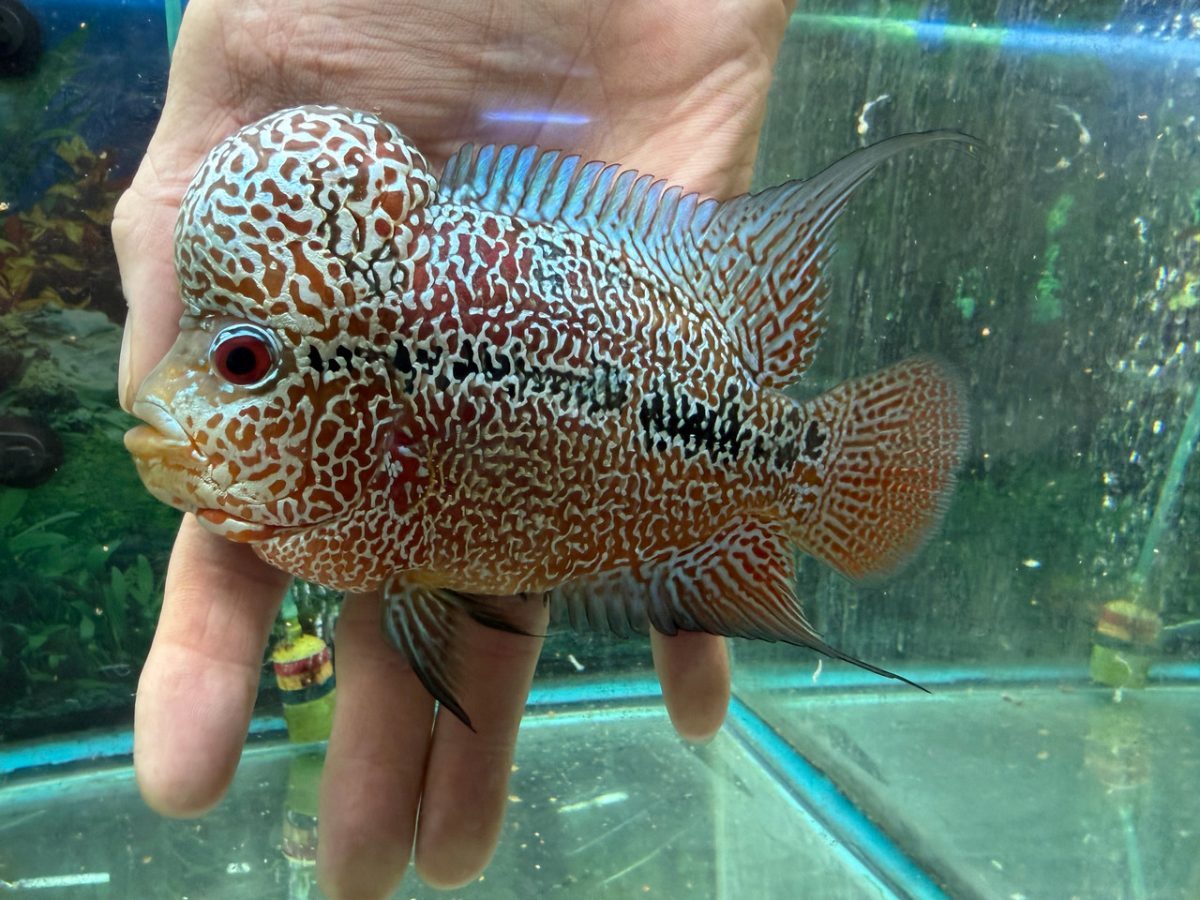
- A size reference such as a hand or ruler. A fish held in a hand, like the one below, makes size easy to read.
- A recent date. Juveniles change fast; a photo from two months ago may not match the fish today.
Be aware that many sellers photograph fish while they flare at a mirror or a hand, which makes the kok look its biggest. That is fair as long as the video shows the fish relaxed too. Back to the buying guide, or learn how to tell males from females.
Questions about flowerhorn grading
What makes a high-quality flowerhorn?
A large, even kok, solid flower markings, dense bright pearling, deep color and a body and fins true to its strain, all on a healthy, active fish. Balance across all of these counts more than one standout feature.
What does AAA grade mean for a flowerhorn?
It is a seller’s label for their top tier. There is no universal standard, so compare the actual fish rather than trusting the letters.
Can a pet-grade flowerhorn get better as it grows?
Somewhat. Good water, diet and space help a fish reach its genetic potential, and color and kok often improve with age, but care cannot add what the genes do not carry.
Why does my flowerhorn look worse than in the seller’s photos?
Shipping stress, a new tank and different lighting commonly dull color and shrink the kok for a few weeks. If water is good, most fish recover their look as they settle.
Sources
- How to grade your flowerhorn, FishLore
- Grading: Kamfa Flowerhorn, Vincenzos Aquatics
- Flowerhorn guides, ThaiFH
- Flowerhorns for sale, Pet Zone Tropical Fish