Buying
Male or female? Sexing a flowerhorn
Every buyer asks it, and for a small flowerhorn the answer is often a guess. Here is what each clue is worth, and at what size it starts to mean something.
Why sexing a young flowerhorn is hard
Flowerhorns have no single, early, foolproof difference between the sexes. The classic male traits (a big kok, long pointed fins, bright color) are the same traits breeders select for in every fish, so a well-bred female can look “male” and a low-grade male can look “female.” On top of that, the most dependable clue, the shape of the breeding tube, only shows clearly in a mature fish.
That is why most fry and small juveniles are sold unsexed. It is not the seller dodging the question. Our own fry listings at Pet Zone say plainly that there is no guarantee on gender, because at 2 to 3 inches (5 to 8 cm) nobody can reliably promise one. Be more wary of the seller who guarantees a male at that size than the one who won’t.
What you can tell at each age
Sizes are a rough guide. Growth depends on the line, food, water and tank size, and some strains mature later than others.
| Size and age | How reliable | Clues worth checking |
|---|---|---|
| Fry, under 3 in (8 cm), first few months | Mostly guesswork | Dorsal fin spots may already show; growth rate hints that the fastest-growing fry in a batch are often males |
| Juvenile, 3 to 5 in (8 to 13 cm) | Educated guess | Dorsal spots, first signs of a kok, fin length and shape; some females start laying eggs |
| Subadult, 5 to 8 in (13 to 20 cm), about 6 months on | Usually clear | Kok size, pointed versus rounded fins, overall size, behavior |
| Mature, roughly 8 months and older | Most reliable | The vent and papilla, egg-laying, all visual clues together |
Hobby guides commonly say differences become easy to see by around 4 inches or six months. Males are generally slower to mature sexually, with breeders often citing up to 8 months.
The visual clues, and what each is worth
Black spots on the dorsal fin
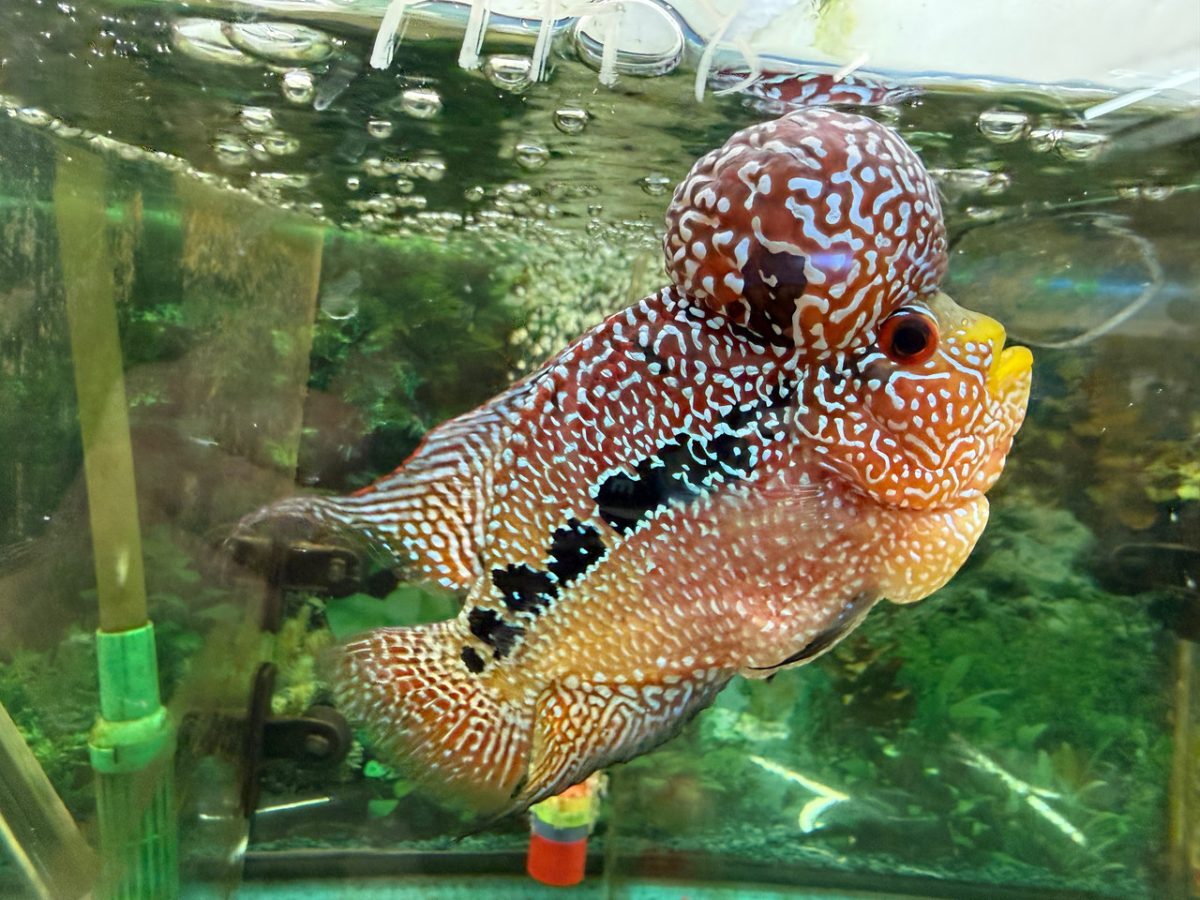
A row of black spots or blotches on the dorsal fin is the best-known sign of a female, and it can appear on fry as small as 2 to 3 inches. One long-circulated hobby guide rates it accurate about 80 percent of the time, which is useful but far from certain. Some males carry spots, and some females only develop them later, after laying eggs or when kept near a male.
The kok
Males usually grow the larger kok, and grow it sooner. Females tend to have a small, firm head or none at all. The exceptions cut both ways: a low-grade male may never grow much of a kok, and some females from strong head lines grow a respectable one. Kamfa and Kamalau fish can also be slow to show a head. More in kok growth.
Fin shape
Mature males tend to have longer dorsal and anal fins that trail to a point. Females’ fins are shorter and more rounded at the tips, and some keepers note a higher-angled dorsal fin on females. This clue firms up with size.
Size and color
In a group, males usually grow faster, partly because they dominate at feeding time. Males also tend to hold brighter, steadier color, while females often darken or show heavier markings when they are ready to breed. On their own, neither size nor color proves much.
The vent and papilla
The most reliable physical test is the papilla (breeding tube), the small tube just behind the anal opening on the underside, in front of the anal fin. It becomes easiest to see when a fish is mature and in breeding condition.
Male
- Narrower, pointed papilla, often described as V-shaped
- Tip points back toward the anal fin
- A mature male may release a little milt when gently vented
Female
- Broader, blunter papilla, often described as U-shaped
- Looks rounder and swollen near spawning
- Visible as the egg-laying tube when she is ready
Venting means lifting the fish and looking at, or gently pressing near, that area. Many breeders consider it the only way to be sure, but it stresses the fish, a slippery flowerhorn can injure itself thrashing, and on a young fish there is little to see. Leave it to someone experienced, or ask the seller to do it and send a clear close-up. You can often see the papilla without handling when the fish hovers near the glass.
Behavior and eggs
Behavior is a weak clue on its own. Males are often the more aggressive, territorial fish, but flowerhorn temperament varies widely, and a bold female is common.
The one behavior that settles the question is egg-laying. Female flowerhorns can lay unfertilized eggs without a male in the tank, and hobby sources report females doing it as small as 3 to 4 inches. If your “male” suddenly cleans a flat rock and deposits a clutch, you have your answer. Remove the eggs within a day or so before they foul the water.
Does it matter which you get?
For a show fish, usually yes. Kok size drives value, and males grow the bigger heads, so premium fish are more often males. If you plan to breed, you need a confirmed pair, and male fertility is its own problem.
For a pet, much less. Females are generally a little smaller and lighter on kok, and still full of the curiosity and hand-feeding personality that makes flowerhorns worth keeping (see the flowerhorn as a pet). Either sex should live alone; the tank mates guide explains why. What you pay for each depends more on grade than sex, as the price guide shows. For judging the fish in front of you, go to how to grade a flowerhorn, or back to the buying guide.
If you want to see larger fish in person, the Mid-City store at Pet Zone in San Diego carries the deepest selection; individual fish are also listed at flowerhorn.co.
Questions about male and female flowerhorns
At what age can you tell if a flowerhorn is male or female?
Visual clues start to mean something at around 4 inches or six months, and become fairly clear on subadults. The vent is most reliable once the fish is mature, often 8 months or older.
Do female flowerhorns have a kok?
Some do, especially from strong head lines, but it is usually smaller and firmer than a male’s. Many females have little or no hump.
Do black spots on the dorsal fin mean a flowerhorn is female?
Usually, but not always. Dorsal spots are a good early hint of a female, yet some males show them, so confirm with fin shape, kok and the vent as the fish grows.
Why are flowerhorn fry sold unsexed?
Because fry cannot be sexed reliably. Reputable sellers say so rather than guess; a guarantee of sex on a 2 inch fish should make you cautious.
Can a female flowerhorn lay eggs without a male?
Yes. Females can lay unfertilized eggs on their own, which is the surest sign of sex. The eggs will not hatch and should be removed.
Sources
- General Care: Sexing your Flowerhorn, Vincenzos Aquatics
- Seven easy ways of sexing your flowerhorn, Flowerhorn Fish Craze
- How to Tell the Difference Between a Male and Female Flowerhorn Fish, Cuteness
- Flowerhorn guides: caring, breeding, determining sex, ThaiFH
- SRD Flowerhorn Fry, Pet Zone Tropical Fish