Care
How big flowerhorns get
A flowerhorn you buy at 3 inches can outgrow a 40 gallon tank inside a year. Here is what the adult size really is, how quickly a fish gets there, and what slows it down.
Typical adult size
A well-grown flowerhorn ends up somewhere around 12 to 16 inches (30 to 40 cm) in total length. That is the figure we use on our care guide, and it matches what most retailer and hobby profiles give. It is also the optimistic end of the story. Plenty of home-kept fish top out nearer 10 to 12 inches (25 to 30 cm), and one widely used care article puts the practical range at 8 to 16 inches with most captive fish staying under 12.
Related: how long flowerhorns live.
Males are the bigger sex. The commonly repeated figure is that a male finishes 1 to 2 inches (2.5 to 5 cm) longer than a female from the same spawn, and heavier and deeper-bodied on top of that. Weights of 1 to 1.5 pounds (0.5 to 0.7 kg) are reported for fish in the 10 to 12 inch range, with the largest going over 2 pounds.
| Typical adult, male | 12–16 in (30–40 cm) |
|---|---|
| Typical adult, female | 8–14 in (20–36 cm) |
| Common home-tank result | 10–12 in (25–30 cm) |
| Most growth finished by | 12–24 months |
| Sexual maturity | About 8–12 months |
Treat any single number as an average with a wide spread around it. Flowerhorns are hybrids from mixed, largely undocumented lines, so two fry from the same box can finish two inches apart on identical care. Never buy a fish on a promised adult size, and be careful of sellers who give one.
How strain and body type change the answer
Body shape is bred in, and it sets the ceiling before you feed the fish a single pellet. Three broad cases come up.
Standard-bodied fish are the baseline for everything above. Most Zhen Zhu, Red Dragon, Golden Base and Kamalau fish fall here. Within that group, keepers generally report that strains differ more in how fast they get there than in where they finish. Thai Silks are often described as slower growers, so a young silk can look undersized next to a ZZ of the same age without anything being wrong.
Kamfa-type fish are usually described as squarer and deeper rather than longer, and as slower to fill out, often looking unfinished at a year and much better at two. That is breeder and keeper consensus rather than measured data, so hold it loosely.
Short body, balloon and bonsai fish are a different animal. The compressed spine that makes the shape also caps the length, and sellers commonly quote roughly half to two-thirds the length of a standard fish. They are not smaller in the ways that matter for husbandry: they eat and foul water like a full-size flowerhorn, and they carry real health risks, covered in our short body guide.
You will also hear about long body lines, a loose trade label for fish selected for a stretched profile rather than a deep one. These are the fish most likely to hit the top of the range on a tape measure, and the ones that need 90 gallons or more as adults rather than 75.
The growth arc, month by month
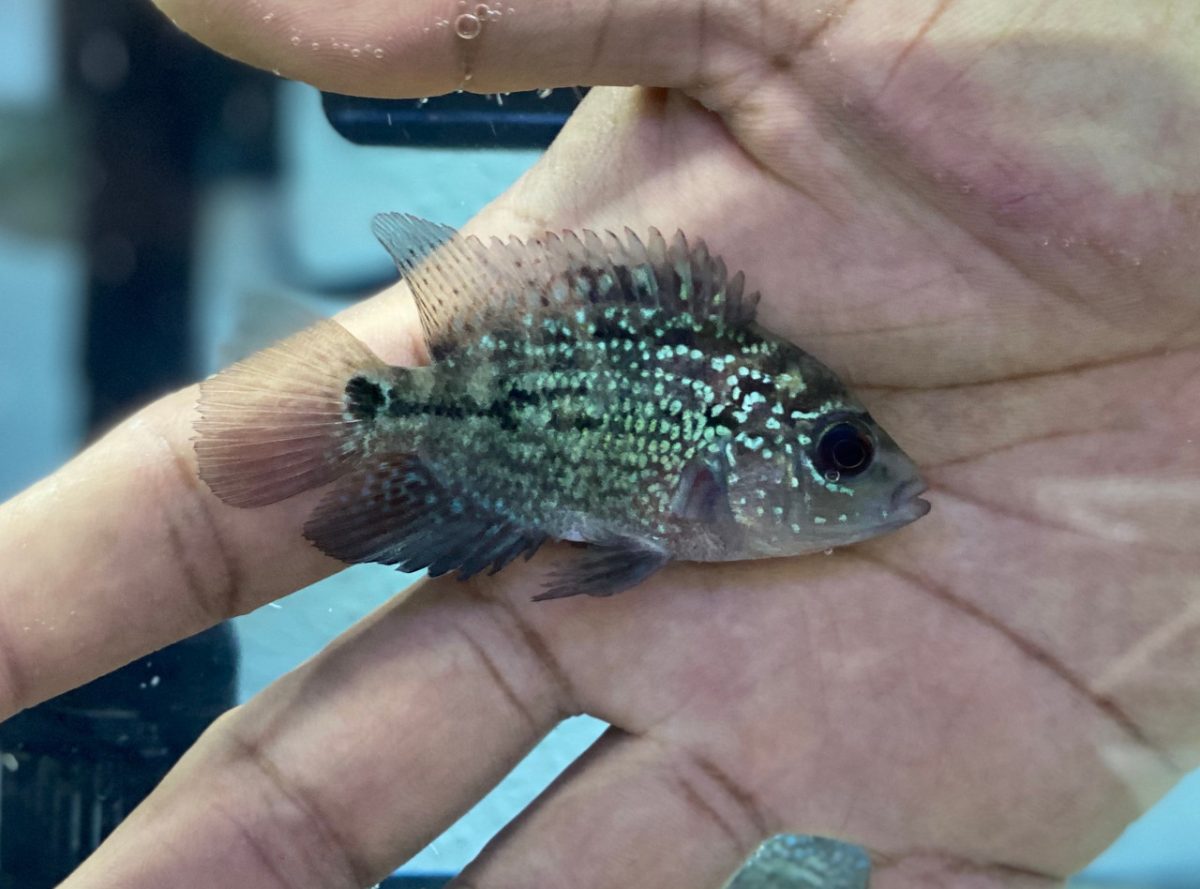
A flowerhorn does most of its growing in the first year, keeps adding length through the second, then mostly thickens. Published growth charts disagree with each other by a lot in the back half of year one, so the table below gives a range rather than a promise.
| Age | Commonly cited length | What is happening |
|---|---|---|
| 1 month | 0.5–1.5 in (1.5–4 cm) | Fry stage. Growth depends almost entirely on food frequency and water changes. |
| 2–3 months | 1.5–3.5 in (4–9 cm) | The fastest stretch in relative terms, often close to an inch a month. Color and first markings appear. |
| 4–6 months | 3.5–6.5 in (9–17 cm) | Males begin to pull ahead and start building a kok. Sexing becomes possible. |
| 7–12 months | 6–11 in (15–28 cm) | The widest disagreement between charts. Conservative ones stop near 7 inches at a year; others put well-grown males over 10. |
| 12–18 months | 8–14 in (20–36 cm) | Length gains slow. The body deepens, the kok keeps filling and color sets. |
| 18–24 months | 10–16 in (25–40 cm) | The last inch or two, added slowly. Most fish are near final size by the end of this period. |
Averaged out, a decent first year runs around three quarters of an inch (2 cm) a month, and keeper reports range from a quarter inch to a little over an inch depending on the fish and the effort. The slowdown after that is normal and not a problem to fix. A two-year-old that has added half an inch in six months is behaving exactly like a two-year-old flowerhorn.
A serious grow-out means small high-protein meals several times a day rather than one big feed, water changes far beyond the weekly minimum, warm stable water, and room to build muscle. Our feeding guide has the schedules by age, and the water and temperature guide covers the rest. None of it turns an average fish into a 16 inch monster, but neglect reliably does the reverse.
What stunts a fish, and the tank-size myth
You will hear that a fish grows to the size of its tank, usually from someone justifying a small one. There is a grain of truth buried in it, and the conclusion people draw from it is wrong.
The grain of truth: fish release growth-inhibiting hormones and pheromones into the water, and in a closed system those build up instead of washing away. The best-documented case is somatostatin in goldfish, where the aquarium veterinarian Richmond Loh describes a substance that limits competition in nature suppressing the fish that made it once it is stuck in a tank. Low volume plus skipped water changes concentrates that, along with nitrate and everything else.
The wrong conclusion: that this is a safe way to keep a big fish small. A stunted fish is one that has not grown at the right rate to the right size for its kind, and it comes with a shortened life, a weakened immune system and a permanently odd shape, usually a small, thin body with a head that looks too big for it. The popular claim that the body stops but the internal organs keep growing is repeated everywhere, and the fishkeeping charity INJAF says plainly that it found no evidence for it. The damage is real without needing that detail.
The things that actually cost a flowerhorn its size, in rough order of how often we see them:
- Too little water. Not the glass itself, but what a small volume does: faster ammonia and nitrite spikes, climbing nitrate, no room to swim hard.
- Water changes skipped. The single most effective growth lever a keeper controls. Grow-out fish are commonly given far more than the 25 to 30 percent weekly minimum.
- Underfeeding, or feeding badly. A juvenile fed once a day on a cheap filler pellet grows slowly. Protein content and meal frequency both matter, especially in the first few months.
- Cool water. Flowerhorns are warm-water fish. Kept at the bottom of the range or below, appetite and growth both drop off.
- Chronic stress. A fish that flares at a neighbor all day spends energy it would otherwise put into growth. See why flowerhorns live alone.
- Untreated illness. Parasites and long-running infections stall growth even when the fish still eats. Our disease guide covers what to look for.
How to measure a flowerhorn properly
Two fish quoted at 10 inches can be visibly different animals, because sellers and keepers measure differently. Biologists use three lengths:
- Standard length (SL): snout to the base of the tail, where the last vertebra ends and the caudal fin begins. Use this for comparing fish: the tail cannot inflate it.
- Total length (TL): snout to the tip of the longest tail lobe. It is the bigger number, and it is what most sellers and most care articles mean when they say a flowerhorn hits 16 inches.
- Fork length: snout to the fork of the tail. Rarely useful on a flowerhorn, whose tail is usually rounded or fan-shaped rather than forked.
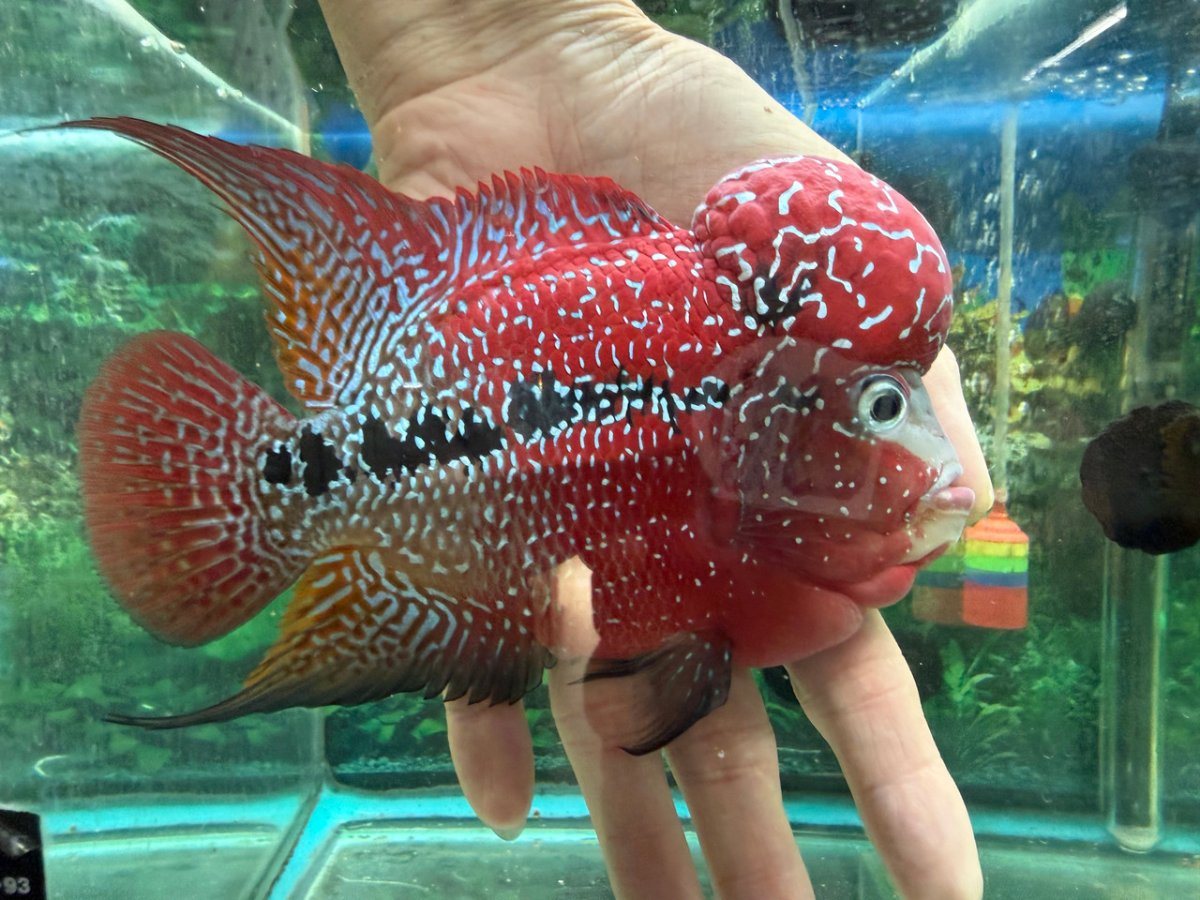
Our own practice: measure nose to tail base, not to the tip, and write down which method you used. It needs no net. Hold a soft tape or ruler flat against the outside of the front glass while the fish is alongside it, and read the length when it lines up. A square-on photo with a ruler taped to the glass works just as well and gives you something to compare against later. Keep the tape level with the fish, since a reading taken at an angle runs long.
If you do lift the fish out, wet your hands first, support it with both, keep it over the water and put it back within a few seconds. An adult flowerhorn is strong and will thrash, and measuring is not worth a scraped slime coat or a fish on the floor.
Measure on the same day each month and log the kok alongside the length. Our growth tracker stores both over time, so you can watch the curve flatten instead of guessing at it.
What that size means for the tank
Size is the reason flowerhorn advice reads the way it does. A fish this big, eating protein-heavy food and digging the layout apart, needs volume, flow and heat in proportion.
Run your own numbers with the tank and equipment calculator.
| Adult tank, minimum | 75 gal (284 L) |
|---|---|
| Large males and long-bodied fish | 90–125 gal (340–473 L) |
| Filter turnover | 5–10x tank volume per hour |
| Heating | 3–5 watts per gallon, split across two heaters |
| Temperature | 80–86°F (27–30°C) |
| Weekly water change | 25–30 percent |
Footprint matters as much as gallons. A fish that finishes at 14 inches wants length and front-to-back depth to turn in, which is why a 48 by 24 inch (122 by 61 cm) footprint suits a big male better than a taller tank of the same volume. The tank setup guide covers the build.
The planning rule: buy the tank for the adult, not the fish in the bag. A juvenile can spend a few months in 40 gallons, but the growth charts say that window is measured in months. If you are picking out a young fish, our grading guide and the listings at flowerhorn.co both help you see what a strain looks like at a given size. If head size is why you are asking about growth at all, read the kok growth guide next: the kok runs on its own timetable.
Questions about flowerhorn size
How big do flowerhorns get?
Most well-kept flowerhorns finish between 12 and 16 inches (30 to 40 cm) in total length, with many home-kept fish nearer 10 to 12 inches. Males run 1 to 2 inches longer than females from the same spawn.
How fast do flowerhorns grow?
Roughly three quarters of an inch (2 cm) a month through the first year, faster in the first few months and slower after. Most fish are near final size somewhere between 12 and 24 months.
Do flowerhorns only grow to the size of their tank?
No. A small tank stunts a fish rather than shrinking it safely: growth-inhibiting hormones and nitrate build up in low volumes, and a stunted fish is left misshapen, weaker and shorter-lived. Size is set by genetics, then by water quality and feeding.
At what size is a flowerhorn fully grown?
Length gains slow sharply after the first year and most fish are done by two. After that the body deepens and the kok keeps developing, but the tape measure barely moves.
Should I measure my flowerhorn with the tail or without?
Measure nose to the base of the tail (standard length) for comparing fish, and note which method you used. Most sellers quote total length, to the tip of the tail, which is the larger number.
Sources
- How Big Do Flowerhorn Cichlids Get? Average Size & Growth Chart, Hepper
- Flowerhorn Size and Growth Chart, Smart Aquarium Guide
- Flowerhorn Growth Chart: From Eggs to 2-year-old, AngryFishes
- Flowerhorn Cichlid Care: A Complete Guide, Aquarium Store Depot
- Do fish grow to the size of their tank?, INJAF
- Fish measurement, Wikipedia