Care
How long flowerhorns live
Most sources land somewhere between 8 and 12 years, and most flowerhorns never get near the top of that. The difference is rarely luck. It is tank size, water, food and what the fish was bred for.
The range, and why sources disagree
Ask five places how long a flowerhorn lives and you will get five answers. The commonly cited figure is 8 to 12 years, and care sites often narrow that to 10 to 12. Keepers on the big cichlid forums report everything from a fish that died at two to one still going at fifteen. None of those people are lying.
Related: how big flowerhorns get.
The spread has real causes, and understanding them is more useful than memorizing a number:
- Body type. The FishLore species profile splits the estimate in two: roughly 8 to 12 years for a standard long-body flowerhorn and about 4 to 5 years for a short body. That one distinction accounts for a lot of the disagreement.
- Line and breeding. The flowerhorn is a hybrid, and lines are made and remade constantly. Long-time keepers argue that older lines from the early 2000s were tougher than a lot of what is produced now, where selection pressure is on head and color rather than vigor.
- What is being measured. Some numbers describe what a fish can reach in ideal conditions. Others describe what actually happens in the average home tank. Those are very different figures.
- Nobody is keeping records. There is no studbook, no survey, no published dataset on flowerhorn longevity. Every figure you read, including ours, is experience rather than data.
| Commonly cited range | 8–12 years |
|---|---|
| Typical with good care | 10–12 years |
| Short body types | Often cited lower, around 4–9 years |
| Reported outliers | Keepers describe fish from 2 to about 15 years |
| Adult size reached | Most growth in the first 12–18 months |
What actually shortens a flowerhorn’s life
Flowerhorns rarely die of old age in home tanks. They die of years of small problems that never got fixed. These are the five we see most, roughly in order of how much damage they do.
A tank that is too small
This is the big one. A flowerhorn in a cramped tank does not simply stay small and content. Chronic crowding suppresses growth, keeps stress hormones elevated and lowers disease resistance, and the fish carries that for the rest of its life. Seriously Fish puts it bluntly in their piece on stunting: a stunted fish often fails to reach a quarter of its potential age, and deformities of the spine and skull show up in fish kept for years in tanks that are too small. Plan on 75 gallons (284 L) minimum for an adult, and 90 to 125 gallons (340 to 470 L) for a big male. The tank setup guide covers the rest, and the tank calculator will size a filter and heater for you.
Chronic poor water
Acute ammonia poisoning kills fast and gets noticed. The slower version kills at year six. A tank that sits at 60 or 80 ppm nitrate between water changes, or one where the filter never quite keeps up with a fish that eats like a flowerhorn, produces a fish that is always a little behind on healing and a little short on immune reserve. It looks fine for years, then it gets hole-in-head or an infection it cannot clear. Weekly 25 to 30 percent water changes are the single cheapest life-extending thing you can do. See water and temperature.
Overfeeding and fatty liver
Flowerhorns beg convincingly and most keepers overfeed them. The Merck Veterinary Manual lists hepatic lipidosis (fatty liver) as a common problem in captive fish, caused by too much dietary fat, too much carbohydrate, rancid food or starvation. It also gives a benchmark: adult fish need roughly 3 percent of their body weight in food per day for maintenance, and fry up to 5 percent. That is far less than most flowerhorns are offered. A heavy, sluggish fish with a dull appetite is not a well-fed fish. Our feeding guide has schedules by age.
Pushing growth
Power feeding, protein-heavy diets aimed at forcing a kok, and running the tank at the top of the temperature range to speed metabolism all buy short-term size at long-term cost. Keepers on MonsterFishKeepers regularly name power feeding and high temperatures when they explain why a fish died young. The same goes for hormone-treated juveniles: the color usually does not hold, and nothing about that trade suggests a longer life. We cover the kok side of this in kok growth.
Short body and other deformities
Short body, bonsai and balloon flowerhorns are bred from a shortened spine. That compression crowds the swim bladder and the organs behind it, and swim bladder trouble, spinal problems and difficulty feeding are common enough that most sellers quote a shorter lifespan. If you keep one, expect more health watching and read short body flowerhorns first.
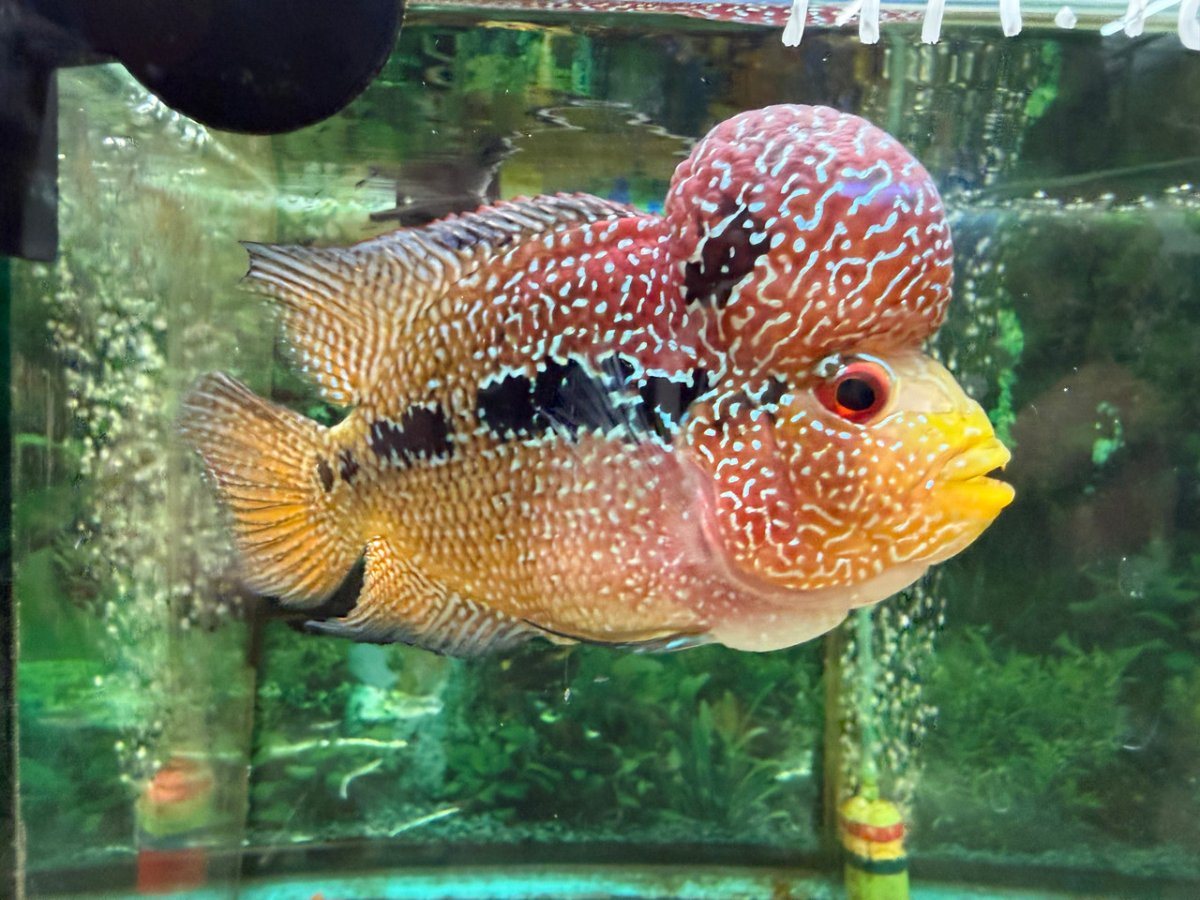
What a flowerhorn life looks like, stage by stage
Ranges overlap and individual fish run early or late, so treat these as the shape of a life rather than a schedule.
| Stage | Age | What it looks like |
|---|---|---|
| Fry | 0 to 3 months | Fast growth on small frequent meals, no kok, no reliable sexing, and the highest losses of any stage. Most of the fish a spawn produces never leave this window. |
| Grow-out | 3 to 12 months | The fastest visible change. Body length piles on, pearling and flower markings resolve, the kok usually starts between 6 and 12 months, and males pull ahead. Almost all lifelong damage from small tanks and bad water starts here. |
| Prime | 1 to 6 or 7 years | Full size, best color, most confident behavior, thickest kok. The fish patrols, greets you, rearranges the tank and generally acts like it owns the room. This is the long middle of the story. |
| Older adult | 7 to 10 years | Growth stopped long ago. Color and kok usually hold if the water does. Activity settles down, appetite gets a little more selective, and old injuries or chronic problems become more obvious. |
| Old age | 10 years and up | Visible decline: thinner through the shoulders, faded color, less interest in food, longer rests on the bottom. Recovery from any setback gets slower. |
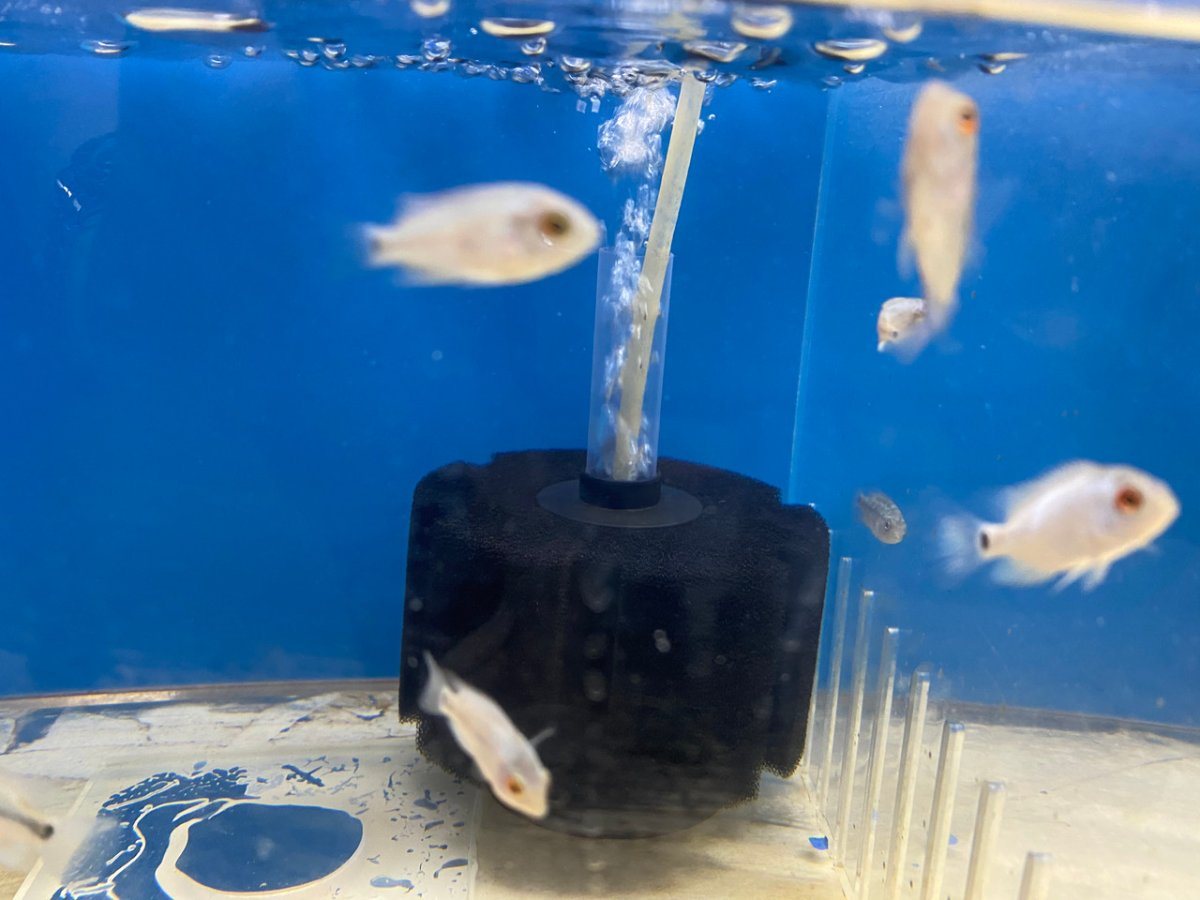
If you want to know where your own fish sits on that curve rather than guessing, log its length and kok once a month in the growth tracker; a year of your own measurements tells you more than any chart written about someone else’s fish.
Signs a flowerhorn is getting old
The hard part is that old age and illness look similar from the outside. The difference is usually pace: aging is gradual and comes as a package, while illness arrives over days and usually brings one symptom out in front. Test your water before you conclude anything is age.
- Slowing down. Less patrolling, more time parked in one corner, less reaction when you walk up to the glass. An old flowerhorn often keeps the greeting habit but puts less into it.
- Color fading. Reds go duller and less saturated, pearling loses some of its flash, and the flower markings soften. Age-related fading is slow and even; a fish that goes dark or blotchy in a week is stressed or sick, not old.
- Kok changes. An old kok often loses a little height and firmness and does not bounce back the way it used to. A kok that shrinks over a few days is telling you about water, stress or illness instead.
- Appetite dropping off. Older fish get pickier and eat less. Offer smaller meals more often and keep watching the belly.
- Losing condition. A dip behind the head, a narrower profile from above, thinner musculature along the back. This is the clearest sign the fish is near the end of its span.
- Slower healing. A scrape from the decor or a nipped fin that would have closed up in a week now takes a month.
Anything that appears suddenly, or comes with clamped fins, gasping, flashing, bloating or white spots, belongs on the diseases page, not on this one. A ten-year-old fish can still catch ich.
How to give a fish the long end of the range
There is no trick here and no supplement worth buying. Every extra year comes from the same short list, done consistently for a decade.
Start with a healthy fish
Buy from someone who can tell you about the parents and the line, and pick the fish that is active, eating and well-proportioned rather than the one with the flashiest head. A fish shipped and acclimated properly starts its life with you in better shape; see shipping and acclimation.
Give it the tank it will need at full size
75 gallons minimum for an adult, more for a large male, with turnover of five to ten times the tank volume per hour. Buying the big tank up front saves the fish the stunting years.
Keep the water boring
80 to 86°F (27 to 30°C), stable, zero ammonia and nitrite, nitrate under 20 ppm, and a 25 to 30 percent water change every week without fail. Boring water is the whole game.
Feed less than the fish asks for
A quality staple pellet, small portions, treats occasionally rather than daily, and a fast day now and then does no harm. Feed for a long life, not for a fast kok.
Keep it alone and keep it calm
One flowerhorn per tank is the rule for a reason. Constant fighting through a divider, or a tank in a high-traffic hallway with people tapping the glass, is a slow tax on the fish. See tank mates.
Catch problems in week one
Look at the fish every day and act on the first thing that seems off. Most of what shortens a flowerhorn’s life is cheap and easy to fix in the first week and expensive or impossible in the third month.
The honest part
Nobody can promise you a number, and you should be suspicious of anyone who does. The flowerhorn is a hybrid built from several Central American cichlids, and the lines behind any given fish are rarely documented. Two juveniles in the same store tank can carry very different constitutions, and you cannot see that from the outside. Some fish arrive fragile. Some shrug off mistakes that should have killed them.
What you control is the environment, and it is worth more than the genetics in practice, because most flowerhorns never get close to their ceiling. A well-kept fish of ordinary breeding will usually outlive a show-grade fish in a 40 gallon tank with a monthly water change. Do your side well, and the number takes care of itself.
If you are still deciding whether to take on ten years of weekly water changes, read the flowerhorn as a pet first, and the rest of our guides are collected in the flowerhorn care guide. If you are ready to pick a fish, you can see what is available at flowerhorn.co.
Questions about flowerhorn lifespan
How long do flowerhorns live?
The commonly cited range is 8 to 12 years, and about 10 to 12 is typical for a well-kept long-body fish. Short body types are usually given lower estimates, and keepers report individual fish anywhere from 2 to roughly 15 years.
Why did my flowerhorn die so young?
The usual causes are an undersized tank, water quality that was poor for a long time before anything looked wrong, and overfeeding. Genetics play a part too, since hybrid lines vary a lot and some fish are simply weaker than others.
Do short body flowerhorns live shorter lives?
Most sources say yes. The compressed spine crowds the swim bladder and internal organs, and sellers commonly quote a shorter span than for a standard flowerhorn, though individual short bodies have lived well past those estimates.
How can I tell if my flowerhorn is old or sick?
Age comes on slowly and as a package: gradual fading, less activity, a smaller appetite and thinning behind the head over months. Illness usually arrives within days and leads with one symptom. Test your water before assuming it is age.
Does tank size really affect how long a flowerhorn lives?
Yes, and it may be the largest single factor. Chronic crowding suppresses growth, raises stress and lowers disease resistance, and stunted fish are widely reported to die well short of their potential age.
Sources
- Nutritional Diseases of Fish, Merck Veterinary Manual
- Stunted growth means stunted lives, Seriously Fish
- Flowerhorn Cichlid Care: Size, Life Span, Tank Mates, Breeding, FishLore
- What is lifespan of flowerhorn?, MonsterFishKeepers
- Flowerhorn Cichlid Care: Tank Mates, Food & Other Tips, Aquarium Source
- What Are Signs of Old Age in Aquarium Fish?, Aquarium Sphere