Care
Setting up a flowerhorn tank
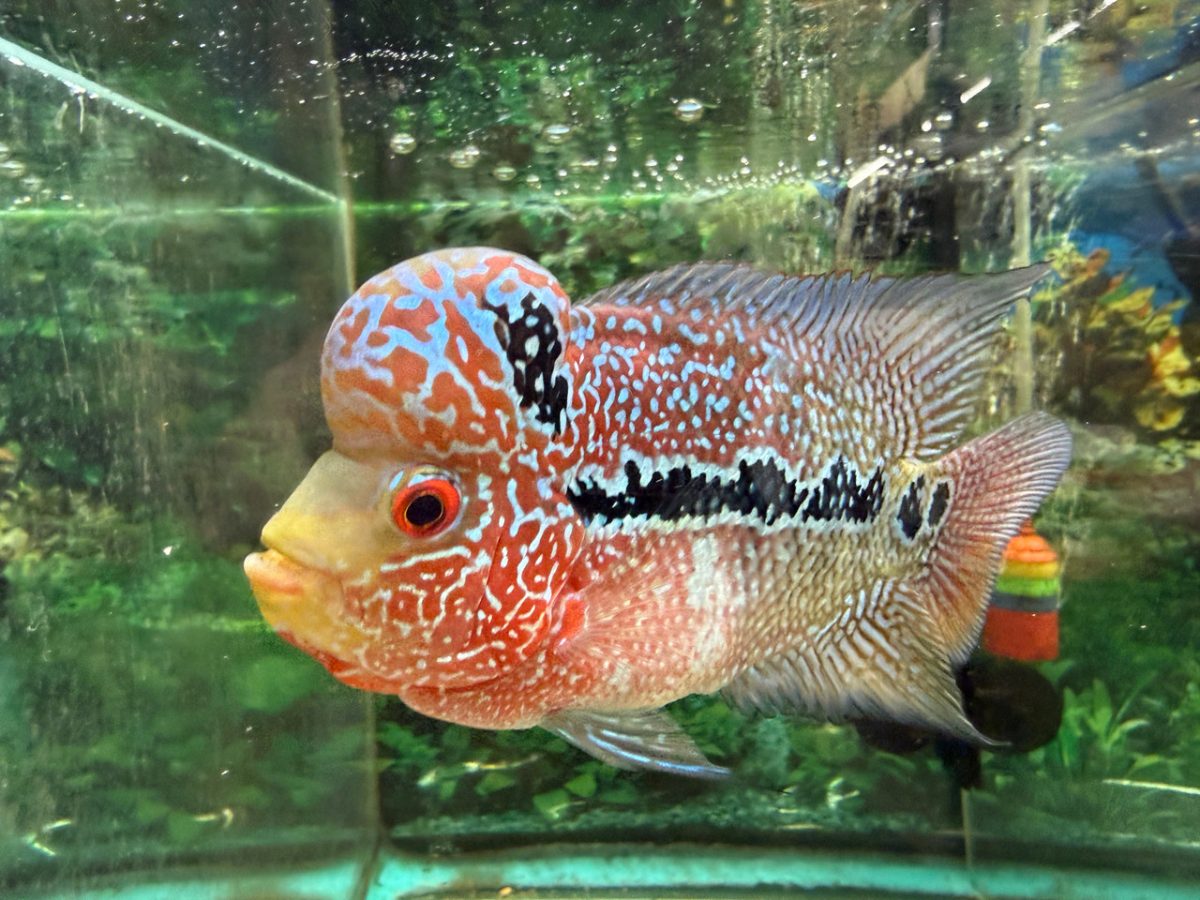
A flowerhorn spends a decade or more in one box of water. Build that box for the adult fish, over-filter it, and make everything inside it strong enough to survive a fish that likes to redecorate.
How big a tank a flowerhorn needs
The number to plan around is 75 gallons (284 L) for one adult. That is a minimum, not a goal. Large males, especially long-bodied fish that reach 14 to 16 inches (35 to 40 cm), are better in 90 to 125 gallons (340 to 473 L). A few references set the floor at 90 gallons, and we would never talk anyone out of going bigger.
Young fish can start smaller, and breeders and stores grow out juveniles in modest tanks all the time. The catch is speed. Commonly cited growth charts put a flowerhorn at around 5 to 6 inches (13 to 15 cm) by six months and near 10 inches (25 cm) by its first birthday. A small tank buys you months, not years.
| Fish length | Workable tank | Notes |
|---|---|---|
| Under 3 in (8 cm) | 20–40 gal (76–151 L) | Short term only. Small water volumes foul quickly with heavy feeding. |
| 3–6 in (8–15 cm) | 40–55 gal (151–208 L) | A grow-out stage. Start shopping for the final tank. |
| 6–10 in (15–25 cm) | 75 gal (284 L) | Move by this point. Cramped fish get stressed and aggressive. |
| Adult, 10 in and up | 75–125 gal (284–473 L) | 90 gallons or more for big males. |
Footprint matters more than height. A flowerhorn swims and turns along the bottom half of the tank, so length and front-to-back depth count. A standard 75 or 90 gallon tank is 48 inches long by 18 inches deep (122 by 46 cm). A 120 gallon at 48 by 24 inches (122 by 61 cm) gives a big male far more room to turn than a taller tank of similar volume.
Filtration: buy more than you think
Flowerhorns eat protein-rich food, eat a lot of it, and scatter crumbs when they do. That makes filtration the piece of equipment most worth overspending on. Hang-on-back filters alone rarely keep up with an adult.
Hobby references give turnover targets anywhere from about 4 to 10 times the tank volume per hour. In practice, that means a 75 gallon tank wants filters moving roughly 300 to 750 gallons per hour, rated for a tank larger than yours. The main options:
- Canister filters. The most common choice. Quiet, hidden in the stand, with plenty of room for biological media. Many keepers run two, so one can be cleaned while the other carries the load.
- Sumps. The best option for big systems. More water volume, room for large amounts of media, and a place to hide heaters where a flowerhorn can’t reach them. They need a drilled or overflow-equipped tank.
- Hang-on-back and sponge filters. Useful as extra flow, backup biological filtration or in a hospital tank, but not as the only filter on an adult.
Whichever you choose, clean mechanical pads regularly and rinse biological media only in old tank water. Chlorine and chloramine in tap water kill the bacteria that keep ammonia at zero. Never clean every filter on the same day. How that bacteria gets established is covered in water, temperature and the nitrogen cycle.
Heaters and temperature control
Flowerhorns do best around 80 to 86°F (27 to 30°C), so the heater runs year-round in most homes. Two problems come up again and again with this fish.
The first is breakage. Flowerhorns push, bite and ram equipment, and a glass heater is an easy target. Use a shatter-resistant or titanium heater, fit a heater guard, or put the heater in a sump or inline on a canister return where the fish can’t touch it.
The second is failure. A heater that sticks on can cook a tank overnight, and one that dies leaves it cold. Split the wattage across two heaters instead of running one big one. Retailer guides commonly suggest 3 to 5 watts per gallon depending on how cold the room gets; some writers argue for staying near 3 watts per gallon in total so a stuck heater can’t overheat the water. For a 75 gallon tank in a heated home, two heaters of about 150 watts each is a typical setup.
A separate digital thermometer is essential, since heater dials are often off by a few degrees. An external temperature controller that cuts power if the water gets too warm is inexpensive insurance on a fish you plan to keep for a decade.
Lids, lighting and where the tank goes
Use a tight, heavy lid. Flowerhorns jump, especially when startled, during water changes or right after they move into a new tank. Cover cutouts for filter hoses and cords with mesh or plastic.
Lighting is mostly for you. Flowerhorns aren’t light-sensitive, and a moderate LED shows off color and pearling without feeding algae. Put it on a timer for roughly 8 to 10 hours a day, so the fish gets a steady day and night.
Placement shapes the fish’s personality. A tank in a living room or office, where people pass all day, raises a curious fish rather than a nervous one. Our guide to the flowerhorn as a pet goes into why. A few practical rules:
- Keep the tank out of direct sun and away from heating and air conditioning vents, which cause algae and temperature swings.
- Use a stand built for the weight. A full 75 gallon setup with water, glass and rock is commonly estimated at roughly 800 pounds (360 kg) or more.
- Make sure the floor is level and solid, and leave room behind and under the tank to reach filters.
- Plug equipment into a GFCI outlet and loop cords below the socket so drips can’t run into it.
Substrate and decor that survive a flowerhorn
A flowerhorn will rearrange its tank. It digs, carries gravel in its mouth, and pushes decor around until it likes the layout. Plan for that instead of fighting it.
What works
- A bare bottom, easiest to keep clean
- A thin layer of fine sand, about 1 inch (2.5 cm)
- A few large, smooth, heavy rocks set directly on the glass
- Solid driftwood too big to move
- A dark background on the back and sides
What causes trouble
- Gravel the fish can swallow, and deep beds that trap waste
- Sharp rock, rough ornaments and resin decor with edges
- Stacked stones that can topple and crack glass
- Live plants, which usually get uprooted or eaten
- Clutter that makes siphoning waste difficult
Bare-bottom tanks look plain, but many serious keepers use them because waste is visible and easy to remove. A dark background, or covering the sides, can cut down on reflections that some fish flare at all day. Whether that affects kok size is a separate question, taken up in the kok growth guide.
Flowerhorn tank setup checklist
Place the stand and tank
Pick the final spot before filling. A full tank can’t be moved. Check that the stand is level.
Add substrate and rock
Rinse sand well, then set heavy rocks directly on the glass or on the bare bottom so they can’t be undermined by digging.
Fill and treat the water
Fill with tap water and add a conditioner that neutralizes both chlorine and chloramine.
Run the equipment
Start filters and heaters, and watch the thermometer for a day or two to confirm the temperature holds steady in the 80s.
Cycle the tank
Build up nitrifying bacteria before the fish arrives. This takes several weeks without help. The water guide explains how to do it and how to know it is done.
Stock food and a test kit
Have a quality pellet ready and a liquid test kit for ammonia, nitrite, nitrate and pH. Our feeding guide covers what to buy.
Bring the fish home
Acclimate slowly, keep the lights low for the first day, and feed lightly for the first few days. If the fish is shipped, follow our shipping and acclimation guide.
If you would rather see fish and equipment in person first, our San Diego store keeps flowerhorns in tanks set up the way this guide describes. For the full care picture, go back to the flowerhorn care guide.
Questions about flowerhorn tanks
Can a flowerhorn live in a 55 gallon tank?
A juvenile can live in 55 gallons for a while, but an adult needs at least 75 gallons. Large males do best in 90 to 125 gallons.
Do flowerhorns need a lid?
Yes. Flowerhorns can jump, especially when startled or in a new tank, so use a secure, heavy lid and cover gaps around cords and hoses.
Is sand or gravel better for a flowerhorn?
A bare bottom or a thin layer of fine sand is best. Gravel can be swallowed while the fish digs or eats, and deep gravel traps waste.
What filter is best for a flowerhorn tank?
A large canister filter or a sump, rated for a tank bigger than yours. Many keepers run two filters so one can be cleaned without losing biological filtration.
Do flowerhorns need a heater?
In most homes, yes. Flowerhorns do best between 80 and 86°F (27 to 30°C), and a guarded or shatter-resistant heater with a separate thermometer keeps it there.
Sources
- How to Care for Flowerhorn Cichlids: Tank, Diet, and Compatibility, AquariumLab
- Flowerhorn Cichlid Care Guide, AquariumStocking
- How Big Do Flowerhorn Cichlids Get? Average Size & Growth Chart, Hepper
- Aquarium Heaters, Aquarium Science
- Aquarium Heating: Heater Types, Wattage & Setup Tips, Petco
- Flowerhorn Cichlid Care, FishLore