Strains
Flowerhorn names, aliases and what they actually mean
Walk a row of tanks and you will count two dozen names for maybe six kinds of fish. Here is what each label usually means, where it means nothing, and what to ask instead.
Why one fish ends up with five names
A customer sends a photo most weeks with the same question: the shop said King Kamfa, the tag said SRD, a forum said ZZ. Which is right? Often all three, because nobody controls flowerhorn names. Four things drive the pile-up.
- No registry and no standard. There is no governing body, no studbook and no agreed written description of what a strain is. Competitions run in Southeast Asia, but their criteria are set by the organizers and none of it follows a fish to a US store.
- Marketing. A new name is free and makes a tank stand out. Once it sells fish, others use it for anything close until it means little.
- Regional naming. A fish picks up a Cantonese name in Malaysia, a Mandarin one in Taiwan, and an English abbreviation by the time it reaches a US shop. 金花 reads as “Kamfa” in Cantonese and “Jin Hua” in Mandarin, and both appear on tanks here.
- Breeder lines. Breeders name their own lines, the way a nursery names a cultivar. Those names mean something to the people who made them and nothing three owners downstream.
So a flowerhorn name tells you what the fish is supposed to look like, not what it is made of. Our strains overview covers the families; this page decodes the labels on the glass.
The name directory
This maps the names we hear most to what the fish usually is. Read every row as “usually”: for most of these you will find keepers who define them differently and sellers who ignore the definition.
| Name | Also sold as | What the fish usually is | Our guide |
|---|---|---|---|
| Luohan | Lou Han, Hua Luo Han | Not a strain. 羅漢 is the general Chinese name for flowerhorns; histories call the original stock luohan. | Origins |
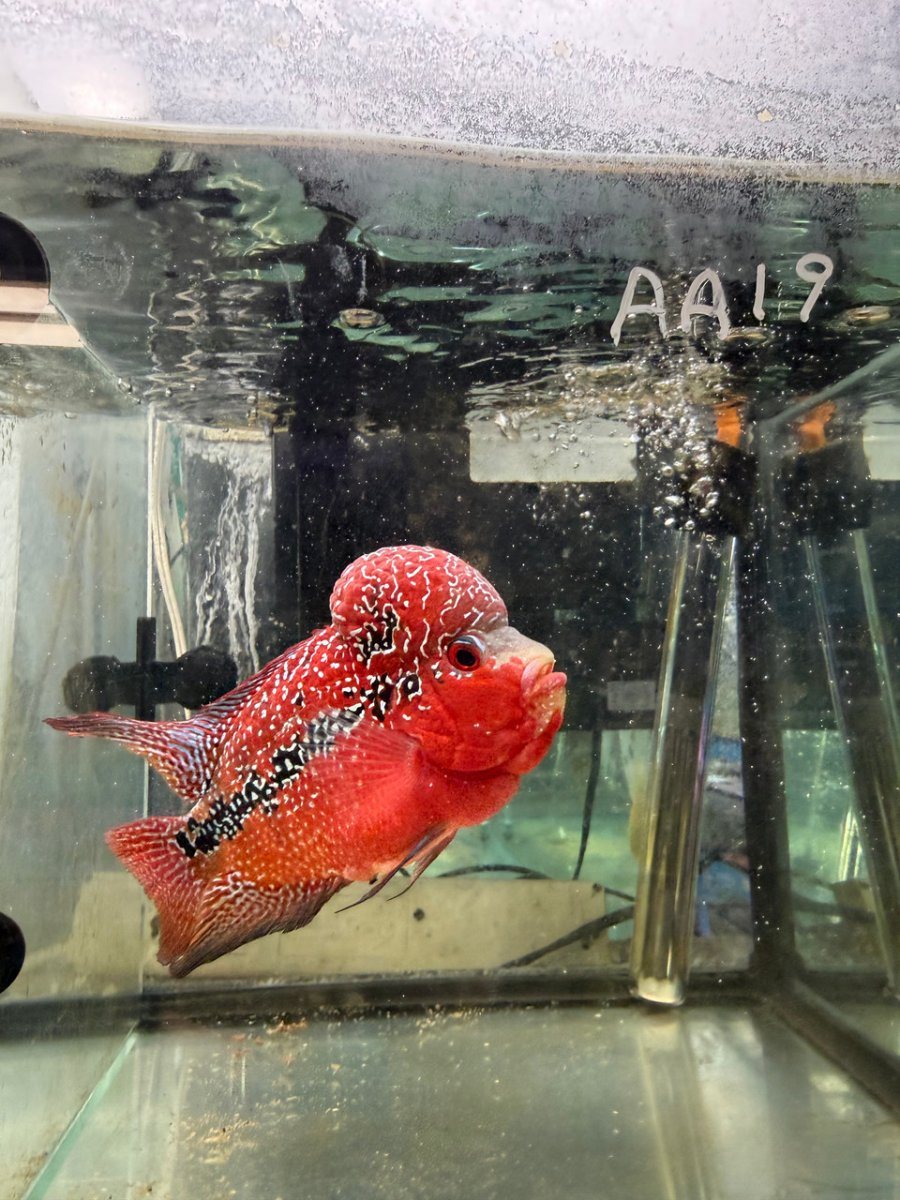
| Zhen Zhu | ZZ, Pearl, pearl flowerhorn | The pearl strain: long body, jutting jaw, bulging red eyes, heavy pearling, firm kok. The base of most US red flowerhorns. | Zhen Zhu |
| Kamfa | Jin Hua, Jing Hua, CK (classic Kamfa) | The square-body family: even lips, often sunken pale eyes, fins wrapping the tail, large kok. Many fish sold as Kamfa are crosses. | Kamfa |
| King Kamfa | KK | A Kamfa show style, not a separate line: thick wormy pearling and a strong double flower row. Usually credited to Vietnamese breeders. | Kamfa variants |
| Emperor Kamfa | Taiwan Kamfa | A Taiwanese Kamfa line named in hobby write-ups. Outside Asia it is rarely backed by anything checkable, so read it as a look. | – |
| Red Dragon | RD | A color line, almost always on a ZZ-type body: red over the front, pearls behind. | Red Dragon |
| Super Red Dragon | SRD, SRD ZZ, SRD Kamfa | The deepest color grade of Red Dragon, not a separate cross. The second half of the tag (ZZ or Kamfa) describes the fish itself. | Red Dragon and SRD |
| Magma | Magfa, Super Magma | A pattern word: red and pearls broken into a cracked, lava-like look, usually on ZZ-type fish. Some retailers now attach it to magenta-red Kamfa instead. | – |
| Thai Silk | Titanium, Mai Thai, Platinum, Cobalt | Metallic silver, white or blue with little or no black flower. Titanium is the usual alternative label; Platinum and Cobalt describe the shade, not the line. | Thai Silk |
| Golden Base | GB, fader, Golden Trimac, Jin Kang | Fish that darken as juveniles, then fade to gold, yellow or orange. “Fader” is the behavior; Golden Base is where it ends up. | Golden Base and faders |
| Golden Monkey | GM, Kam Lau | Two meanings: historically a prized Malaysian line with a chubby face and heavy head pearling, today often any gold flowerhorn. Cantonese for gold monkey, 金馬騮. | Golden Monkey |
| Kamalau | KML, Malau, Kamfamalau, KFM | Kamfa crossed into Malau or Golden Monkey stock: a thicker “monkey” face with Kamfa fins and eyes. Keepers disagree where Malau ends and Kamalau begins, and some use KML for Kamfa crossed to Red Dragon ZZ. | Kamalau |
| Short body | SB, bonsai, balloon | A body shape, not a color line: a shortened spine on any strain. Bonsai usually means the most extreme version, though sellers vary. | Short body and bonsai |
| Red Texas | RT, Super Red Texas, SRT | Not a flowerhorn. A separate hybrid built on Texas cichlid stock crossed with a red Central American cichlid or a red parrot. Sold beside flowerhorns and often mixed up with them. | Hybrid cichlids |
| Fortune Fish | FF | An older trade name, described in hobby writing as a Texas or Herichthys carpintis cross with a Vieja. Still used for stocky, red-fronted hybrids. | – |
Two things to notice. Abbreviations collide: one strain guide lists SRT as short body, while most of the trade reads it as Super Red Texas. And names stack. “SRD ZZ short body” is three labels doing three jobs, which is the clearest kind of tag you can get.
Names that describe a grade, a color or a shape
Much of what looks like strain vocabulary is not lineage at all. Sorting the two apart solves most of the confusion.
These describe the fish in front of you
- SRD, super red, high red: how much red, how deep.
- AAA, AA, A, B, C: seller grades, applied differently by every shop. An AAA on one site is not an AAA on another.
- Fader: a fish that will change color, whatever line it came from.
- Short body, bonsai, balloon: spine length.
- Water head, hard head: kok texture, covered in our kok growth guide.
- Platinum, cobalt, wormy, double flower: pattern and shade words.
These claim something about ancestry
- Kamfa, ZZ, Kamalau, Golden Base: families with a recognizable structure.
- F0 to F4: Kamfa generation claims, not strains and not quality grades.
- Named breeder lines: only as good as their records.
- Malau, Golden Monkey: historical lines whose names now travel further than the fish did.
A grade word is a claim you can check. Score the fish with the flowerhorn grading scorecard and compare the number to the price.
A fish tagged “AAA Super Red” has been graded, not identified. One tagged “Kamfa” has been identified, not graded. You want both, and our grading guide covers doing it with your own eyes.
Names that are mostly marketing
Most sellers use the names their supplier gave them. But some labels carry no information, and it is worth knowing which.
- Any name with Super, King, Emperor, Imperial or Royal in front of it. Occasionally these mark a real show style, as with King Kamfa. More often they are a price tier. Older hobby writing already warned that ZZ had spawned a crowd of sub-names with nothing behind them but marketing.
- Invented color names. Magma, Ruby, Lava and their cousins describe a look somebody liked. Two sellers using one word rarely mean the same fish.
- “Imported” and “Thai bloodline.” Both can be true and neither is checkable from a listing. Ask which farm; a seller who knows will tell you.
- Grade inflation. A standing complaint in cichlid forums is “super” on a fish showing very little of whatever it is supposed to be super at.
- Brand-new names. A name on one store’s site and nowhere else is a house label. That does not make the fish bad; it means the name buys you nothing.
Price and name move together whether or not the fish agrees. Our price guide covers what drives cost: size, sex, grade and how much of the adult look already shows.
Where flowerhorn names bleed into other hybrids
Flowerhorns are not the only man-made Central American cichlids on the shelf, and the names blur at the edges.
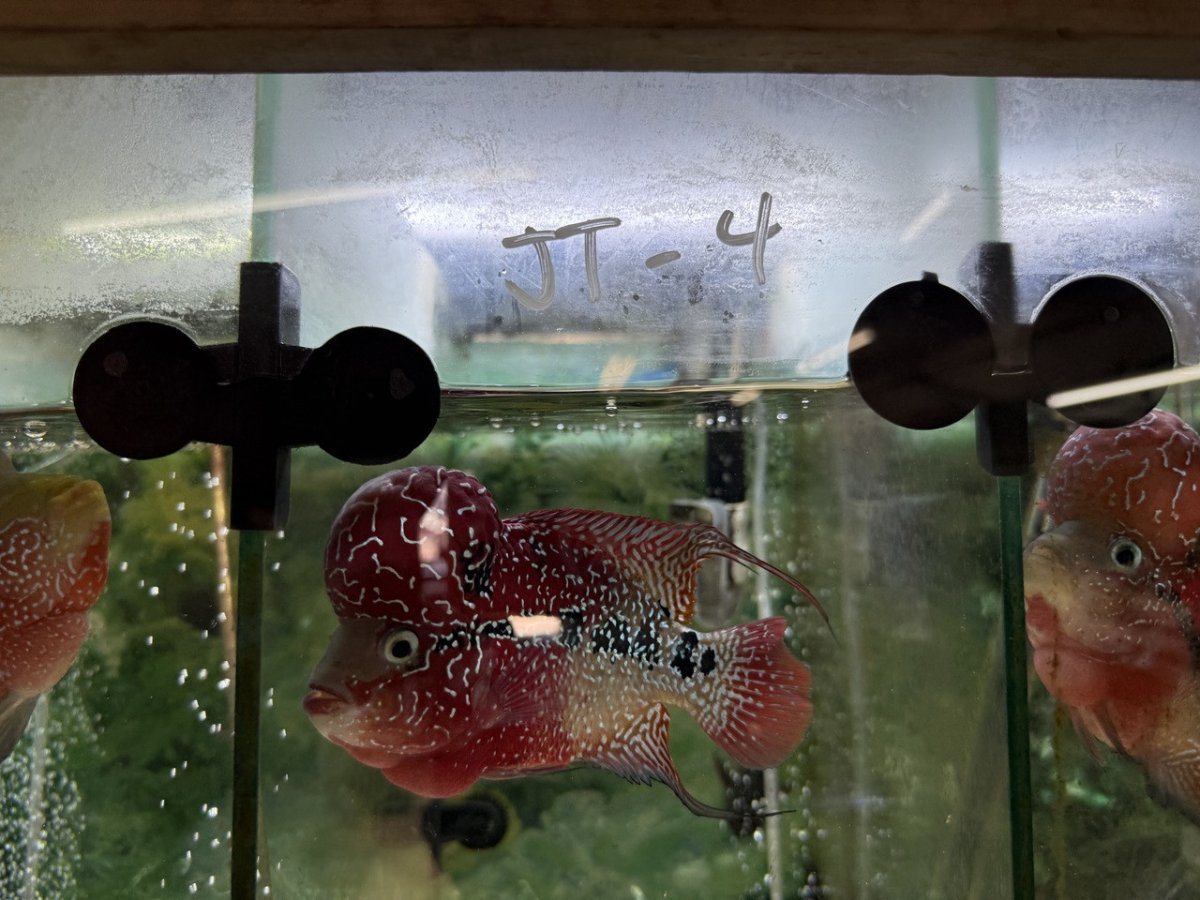
Red Texas and Super Red Texas are the biggest overlap. Accounts differ: one European importer describes the cross as a male Texas cichlid with a red parrot female, appearing around 2004, while many hobby breeders describe Herichthys carpintis crossed with a red Amphilophus. Either way it is a separate project, judged on solid red and clean pearling rather than kok size. Chain-store fish labeled Red Texas are regularly called flowerhorns or mixed hybrids by forum keepers, and the reverse happens too.
Parrot crosses are the other. King Kong parrots sit in the flowerhorn family tree, and fish sold as flowerhorns sometimes show a short parrot face or pinched mouth. Our flowerhorn vs blood parrot page walks through the tells, and the King Kong parrot page covers that line.
None of this makes a mislabeled fish a bad pet. It matters when you are paying strain prices, or breeding and need to know what is going in the tank.
How to ask the seller a useful question
Arguing about a label goes nowhere. A question with a checkable answer works better, and tells you plenty about the seller either way.
-
“What are the parents, and do you have photos of them as adults?”
The only question that gets at lineage. A breeder, or a shop buying from one, can usually answer. A seller who cannot is passing along a name, which is fine as long as everyone knows it.
-
“Is that name describing the line or the look?”
Most sellers will tell you straight: it is a ZZ, and they call that color Magma. That one sentence resolves nearly every naming argument.
-
“How old is it, and how long have you had it?”
Age sets what you can predict. A three-inch fish has not settled its kok, color or often its sex. A fish grown out for two months has shown the shop how it eats and behaves.
-
“What has it been fed?”
Heavy color-enhancing food on a small fish can put up color that does not hold. Compare the answer against the staple diet in our feeding guide.
-
“Can you send a short video of it moving?”
Thirty seconds of video answers more than any label: posture, fin carriage, how it tracks your hand. For a fish bought sight unseen it is the best thing to ask for.
To ask all of this across a counter, our shop is Pet Zone in San Diego, and we ship nationwide through flowerhorn.co. Terms not on this page are probably in the glossary.
Questions about flowerhorn names
Is there an official list of flowerhorn strains?
No. There is no registry, studbook or governing body, so strain names come from breeders and sellers and spread by use. Competitions in Southeast Asia apply criteria set by their own organizers, the closest thing to a standard.
Are Thai Silk and Titanium the same fish?
In everyday use, yes. Titanium is the usual alternative name for the metallic silver and blue flowerhorn most sellers call Thai Silk, and Mai Thai turns up too. Some keepers reserve Titanium for particular shades, so ask.
Is a Red Texas a flowerhorn?
No. It is a separate man-made hybrid built on Texas cichlid stock rather than the flowerhorn lines. Both are Central American cichlid hybrids sold side by side, and mislabeling runs both ways at chain stores.
What does SRD ZZ mean?
Two labels doing two jobs. SRD is a color grade, Super Red Dragon; ZZ is the body type, Zhen Zhu. Together they describe a pearl-strain fish selected for deep red, which is about as informative as tags get.
Does a fancier strain name mean a better fish?
Not on its own. Grade, size, sex and how much adult character already shows drive value, and all of those can be checked by looking. If two fish look alike, the fancier name is not worth more.
Sources
- Flowerhorn cichlid, Wikipedia
- Strains of flowerhorns and more, Flowerhorn Rus Forum
- Kamfamalau, Flowerhorn The Hybrid Cichlids
- Flowerhorn grading and types, MonsterFishKeepers forum
- The Red Texas cichlid that isn’t?, MonsterFishKeepers forum
- Red Texas cichlid, Aquarium Glaser