Strains
Kamfa flowerhorns
The Kamfa is the flowerhorn people point at: square body, huge head, pearls to the tail. It is also the strain with the most confusing labels and the hardest time breeding.
Where the Kamfa came from
Kamfa is one of the lines usually counted among the founding flowerhorn varieties, and today it is the one most collectors aim for. Hobby accounts place its development in Malaysia and Thailand after the first flowerhorn boom of roughly 1998 to 2002, though, like most flowerhorn history, the story was passed along by breeders rather than written down.
The recipe is where accounts diverge. The version most sources agree on is that breeders crossed early flowerhorns with Vieja cichlids, which brought in a big, square frame, strong fins and heavy pearling. Other breeders describe Kamfa being made from Zhen Zhu fish crossed with parrot-type cichlids, including King Kong and mammon parrots. Both may be true of different lines, which is part of why two “Kamfa” can look quite different.
The name is usually explained as the Cantonese reading of 金花, “golden flower,” and the same fish is sometimes sold under the Mandarin reading, Jin Hua. For the wider story of how the flowerhorn itself was built, see flowerhorn origins.
What makes a Kamfa look like a Kamfa
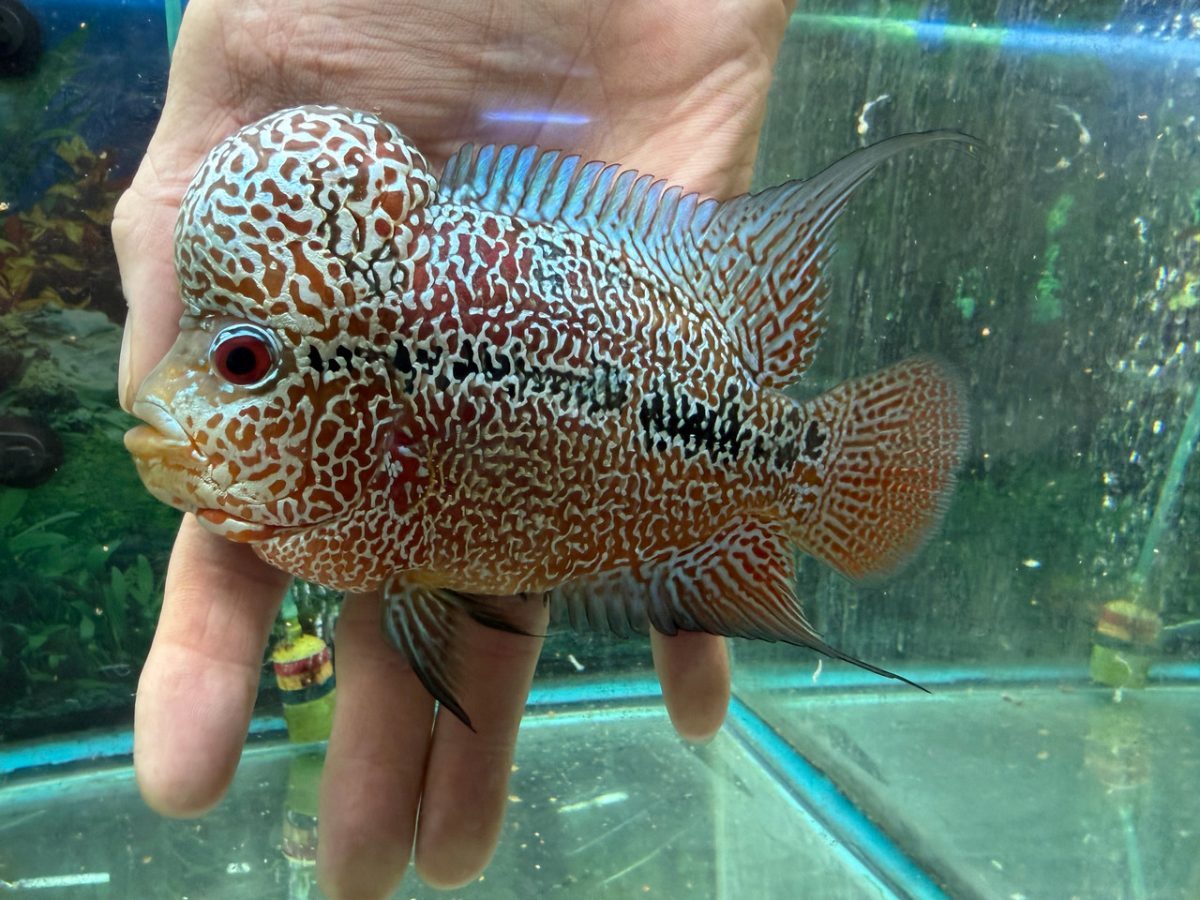
A Kamfa is identified by structure first. Color varies widely within the strain, so look at the outline of the fish, then the face, then the fins.
| Body | Square, deep and compact. A long, tapering body points toward Zhen Zhu. |
|---|---|
| Mouth | Even, rounded lips with no obvious underbite. ZZ fish typically have a lower jaw that juts forward. |
| Eyes | Traditionally white, yellow or orange, and set in or “sunken.” Modern Kamfa and King Kamfa can have red eyes. |
| Fins & tail | The dorsal and anal fins wrap around the tail so the back end reads as one fan. Tail rays should stand upright, not droop. |
| Kok | Large and tall, often a softer water head (more below). |
| Pearling | Dense over the face and body in most lines. Fader Kamfa are the exception and may show few or no pearls. |
| Color | Anything from pinkish red to deep red and blue-red, often with a metallic sheen. |
One hobby rule of thumb says a fish should show at least three quarters of these traits to be called Kamfa. That is a useful way to think about it: no single feature decides it, and plenty of fish sold as Kamfa are really Kamfa crosses. For a side-by-side with other strains, see the strains overview.
F0 to F4: what the generation labels mean
Kamfa is the strain where you will see generation labels on the tank. They describe how far a fish is from the original Kamfa cross. They are not separate strains, and they are not a grade of quality.
| Label | What it claims | What to expect |
|---|---|---|
| F0 | The original cross between an early flowerhorn and Vieja | The purest Kamfa traits and nearly infertile. Rarely what a hobbyist actually buys. |
| F1 | Direct offspring of the original cross | Very strong Kamfa character. Breeding is difficult but possible. |
| F2 | The next generation on | Commonly described as the generation most often on the market. Easier to raise than F0 and F1. |
| F3 | Further crossed | Commercial-grade Kamfa: easier to feed and raise, and better at breeding. |
| F4 | Deeply crossed | Easy to keep and breed, with the least Kamfa purity. |
Two cautions. First, not everyone counts the same way. Some breeders call the original parents F0 and their first cross F1, which shifts every label by one. Second, and more important, generation cannot be confirmed by looking. A big head or dense pearls do not prove a fish is F1, and there is no registry that tracks these lines. The label is only as good as the seller’s records and honesty.
The water head kok
Kamfa are known for the water head: a large kok that is softer and holds more fluid than the firmer hard head typical of Zhen Zhu. Hobbyists often say a water head looks translucent when a light shines through it. A good one can grow to an enormous, rounded dome, and it is a big part of why top Kamfa command the prices they do.
The trade-off is that water heads are less stable. Stress, a move, poor water or illness can make the kok shrink, sometimes within days. It usually comes back once the fish settles and conditions improve, but a water head that looked perfect in a breeder’s photo may look smaller the week after shipping. Not every Kamfa carries one, either: classic Kamfa lines are described as having semi-hard or hard koks, with water heads appearing in some fish.
Genetics set the ceiling on kok size. Warm, clean water, a quality high-protein diet and a fish that feels secure help it get there. Our kok growth guide covers what works and the myths that don’t.
Why Kamfa are hard to breed
The same crosses that gave Kamfa their structure also gave them poor fertility. Many males are sterile, maturation takes longer than in ZZ lines, and breeders who do get fertile spawns still find that only a small share of the fry grow into show-type fish.
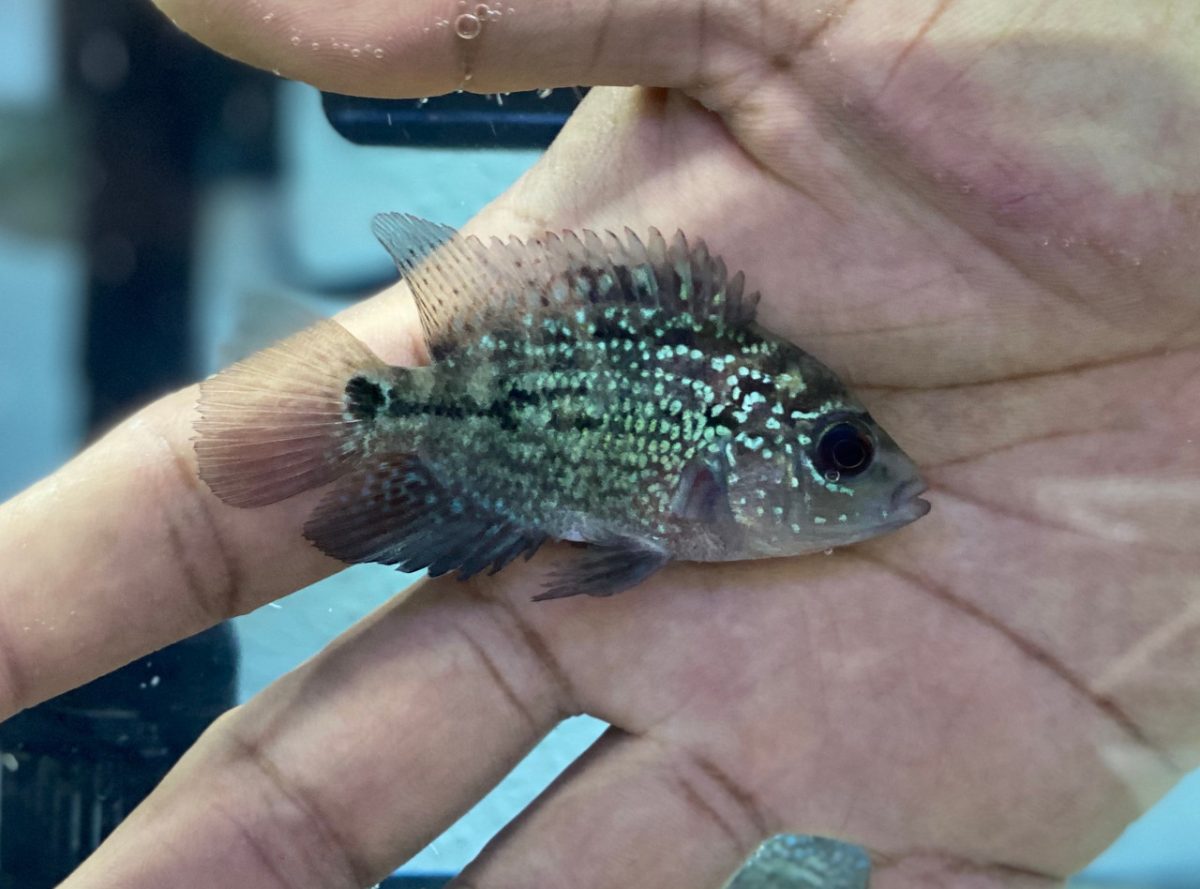
A widely repeated rule of thumb links eye color to fertility: white- or yellow-eyed Kamfa are more often sterile, while red-eyed Kamfa have a better chance of being fertile. It is hobby lore rather than tested science, and some breeders read a red eye as a sign of ZZ blood in the fish. Either way, it explains a common practice: pairing a show-quality Kamfa female with a proven male from a more fertile line, or crossing back to ZZ and then selecting the Kamfa-looking offspring. The breeding guide walks through pairing and spawning.
Kamfa are also commonly described as more sensitive to swings in water conditions than ZZ fish. In practice that means a stable heater, a good filter and regular, consistent water changes rather than big occasional ones. See water and temperature for the routine.
King Kamfa and other Kamfa names
Kamfa is a family with many branches, and seller names are not standardized. The ones you are most likely to meet:
- King Kamfa: selected for an intense black double flower row and thick, wide, often wormy pearling over the upper body. It is often credited to Vietnamese breeders and is widely considered one of the most desirable show styles.
- Classic Kamfa (CK): the older Vieja-heavy type, with a big square body and large fins, red that can wash toward pink, and a semi-hard kok. Breeders use CK to put Kamfa structure back into lines that have drifted.
- SRD Kamfa: Kamfa structure with Super Red Dragon color, like the fish pictured above. See Red Dragon and SRD.
- Kamalau (KML): a Kamfa cross with its own following. It has its own guide.
- Fader Kamfa: Kamfa that go dark and then fade to a solid base color, usually with few pearls, much like Golden Base fish.
Buying a Kamfa
Kamfa are where buyers most often pay for a label instead of a fish. A few habits help:
- Judge structure, not paperwork. Check the body outline, mouth, eyes and fin wrap against the table above.
- Ask what the generation claim is based on. A seller who knows the parents can tell you. One who can’t is guessing.
- Be realistic about juveniles. Young fish change a lot, and a small fish with an early head and intense color may not keep either. Ask for photos of the parents as adults.
- Plan for a male if you want the head. Males usually grow the bigger kok. Our guide to sexing flowerhorns explains what can and can’t be told at each age.
- Watch the fish move. An alert Kamfa that follows you along the glass is a healthier bet than a prettier fish sulking in a corner.
Pet Zone keeps Kamfa, SRD ZZ and Thai Silk flowerhorns in our San Diego store, and ships fish nationwide through flowerhorn.co. For what drives price, see flowerhorn prices.
Questions about Kamfa flowerhorns
What does F2 Kamfa mean?
It means the fish is claimed to be two generations on from the original Kamfa cross. F2 Kamfa are commonly described as the most available generation, easier to raise than F0 or F1 while keeping strong Kamfa traits.
How can I tell if my flowerhorn is a Kamfa?
Look for a square body, even rounded lips, sunken white or yellow eyes and dorsal and anal fins that wrap around an upright tail. Most fish show some of these traits, and a fish with only a few is more likely a Kamfa cross.
Why did my Kamfa’s kok shrink?
Water head koks often shrink with stress, a move, poor water quality or illness. Test the water, keep conditions stable and feed well, and the kok usually recovers over the following weeks.
Are Kamfa flowerhorns fertile?
Often not, especially males. Lower generations are the least fertile, and later generations such as F3 and F4 breed more easily.
Sources
- Origins of Kamfa F0–F4 lines, PNPV Fish House
- What makes a flowerhorn a Kamfa?, FlowerHorn Tips
- What is F1 Kamfa?, MonsterFishKeepers
- Breeding and strains: Classic Kamfa, Vincenzo’s Aquatics
- Kamfa, Flowerhorn The Hybrid Cichlids
- Strains of flowerhorns, Flowerhorn Rus Forum