Strains
Red Dragon and Super Red Dragon flowerhorns
Red Dragon is the flowerhorn most people picture: a blaze of red under a frost of pearls. How red a fish gets, and stays, comes down to genes, food and a fair amount of patience.
What a Red Dragon is
Red Dragon is a color line more than a body type. Breeders select fish for deep, even red, and most Red Dragons are built on a Zhen Zhu frame: a longer body, red eyes, a jutting lower jaw and a firm kok. The line is generally associated with breeders in Malaysia and Thailand, but no reliable record of who first fixed the color exists, and we would treat any exact origin story with caution.
A typical Red Dragon shows:
- Red on the front of the body: face, kok, throat and chest, spreading back toward the middle.
- Pearled sides: white or silver pearls, especially over the rear half.
- A dark flower line: black markings along the side, bold in some fish and broken in others.
- A pearled kok: on good fish, the pearling runs right up over the head.
You will sometimes see Red Dragons described simply as pink-to-red flowerhorns. That is the lower end of the range. What buyers pay for is how deep the red is and how far back it reaches.
Red Dragon vs. Super Red Dragon (SRD)
Super Red Dragon, or SRD, is not a separate cross. It is a higher grade of Red Dragon: a fish whose red is more saturated and covers more of the body, commonly described as more than half its length. Experienced keepers are quick to add that the line between the two is fuzzy, and a brightly colored RD can outshine a mediocre SRD.
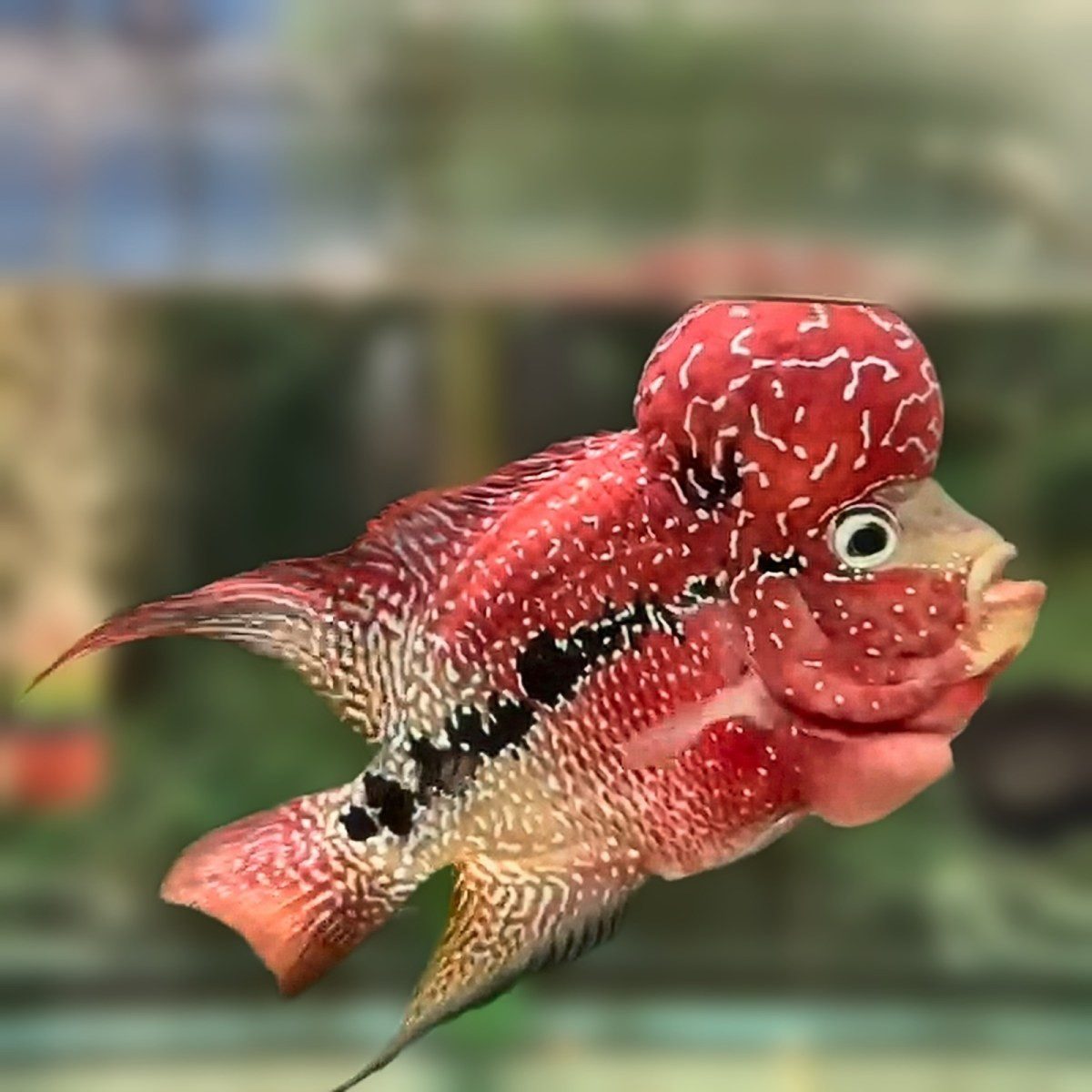
| Red Dragon (RD) | Super Red Dragon (SRD) | |
|---|---|---|
| Red coverage | Face and front of the body | Front half or more, often reaching well past the midline |
| Depth of color | Pink-red to red | Deep, solid, blood red |
| Pearling | Present, often strongest on the rear half | Clean pearls over the red, including the kok on better fish |
| Body underneath | Usually ZZ-type | Usually ZZ-type (SRD ZZ); SRD Kamfa also exists |
| Who decides | The breeder or seller. There is no written standard, so compare fish side by side instead of trusting the label. | |
This is why you see names like SRD ZZ and SRD Kamfa. The first part is the color grade and the second is the structure. An SRD Kamfa carries Red Dragon color on a square Kamfa body, usually through crossing. For how SRD compares with other lines, see the strains overview.
How the red develops with age
A Red Dragon isn’t born red. Very young fry are drab, and the markings and first pearls show before the color does. Red usually builds through the juvenile months, and a well-bred SRD can already show strong red and pearls by 2.5 to 3.5 inches (6 to 9 cm), the size our own SRD fry are usually listed at.
From there, expect change. Color in young flowerhorns keeps shifting for months, and keepers describe some fish taking close to a year to settle. Along the way:
- Some fish go through a dark or patchy phase. Fading, where young fish shift their black pigment, often starts around 1 to 2 inches, though some fish change much later. A fish that turns patchy isn’t necessarily losing its red for good.
- Surroundings change the shade. Keepers commonly report fish darkening on black substrate, and a newly bought SRD can look dull or dark for its first weeks.
- Stress shows in color first. Poor water, a bully through a divider or a recent move can wash a fish out in days.
- Pearls should stay. Fading involves the dark pigment. If the pearls themselves are disappearing, look harder at water quality and health.
If you are choosing a young fish, look at the parents if you can. The color a Red Dragon can reach is set by its genes; care decides how close it gets.
Where red comes from: genes and carotenoids
Red and orange in fish come largely from carotenoids, pigments such as astaxanthin (red) and canthaxanthin (orange-red) that are stored in the skin. Fish cannot make carotenoids from scratch. They have to eat them, and pigmentation reviews note that color fades over time when those pigments are missing from the diet.
So there are two parts to a red flowerhorn. Genetics decide how many pigment cells a fish has and where they sit, which is why an SRD and a pet-grade fish on the same food look nothing alike. Diet supplies the raw material those cells need to show color.
That trial, on the flowerhorn’s hybrid cousin the blood parrot, carries a lesson for flowerhorn keepers: more color food isn’t automatically more color. A quality pellet that already lists astaxanthin or similar pigments covers most of what a Red Dragon needs.
Color-enhancing food and the fading question
A common worry among SRD owners is some version of “he was redder in the store.” Often the fish is just settling in. Sometimes it is something else, and it helps to know the difference.
Pushed color
Juveniles are commonly fed heavy color-enhancing diets before sale, and buyers are routinely warned that color pushed with feed may not last. A fish switched to a plain diet can lose some intensity over the following weeks. It keeps its genetic color, but the extra pigment from the diet can fade.
Hormones
Hobby forums also discuss hormone-laced foods marketed to speed up development, and experienced keepers advise against them because of the health risks. Hormone treatments are used in flowerhorn aquaculture: a Thai study, for example, used androgen immersion to raise the share of males in a batch. Whether any particular fish for sale was treated is almost impossible to verify, so the best protection is buying from a seller who will tell you how their fish were raised.
Settling, light and stress
Before blaming either, rule out the ordinary causes. A new tank, a darker substrate, different lighting and a few weeks of stress will all dull a Red Dragon. Aquarium lights with a strong red or pink spectrum flatter red fish, so the same fish under plain white light can look less vivid without having changed at all.
The practical answer: give a new fish several weeks of stable water and good food before judging its color, and don’t chase it with ever-stronger color products. Our feeding guide covers staple pellets and treats.
Keeping a Red Dragon red
Red Dragons don’t need special care beyond good flowerhorn husbandry, but color is the first thing to slip when husbandry does. The habits that matter most:
- Stable, clean water. Regular water changes and steady temperature. See water and temperature.
- A quality staple with pigments. Feed a flowerhorn pellet as the base, and use color-enhancing formulas as part of the rotation rather than the whole diet.
- No overfeeding. Uneaten food fouls water, and poor water costs color faster than any food adds it.
- A setting the fish is comfortable in. A bare or light-colored bottom shows red better than black gravel.
- A confident fish. Flowerhorns color up when they feel secure and engaged. Time at the glass with you counts; see the fish that acts like a dog.
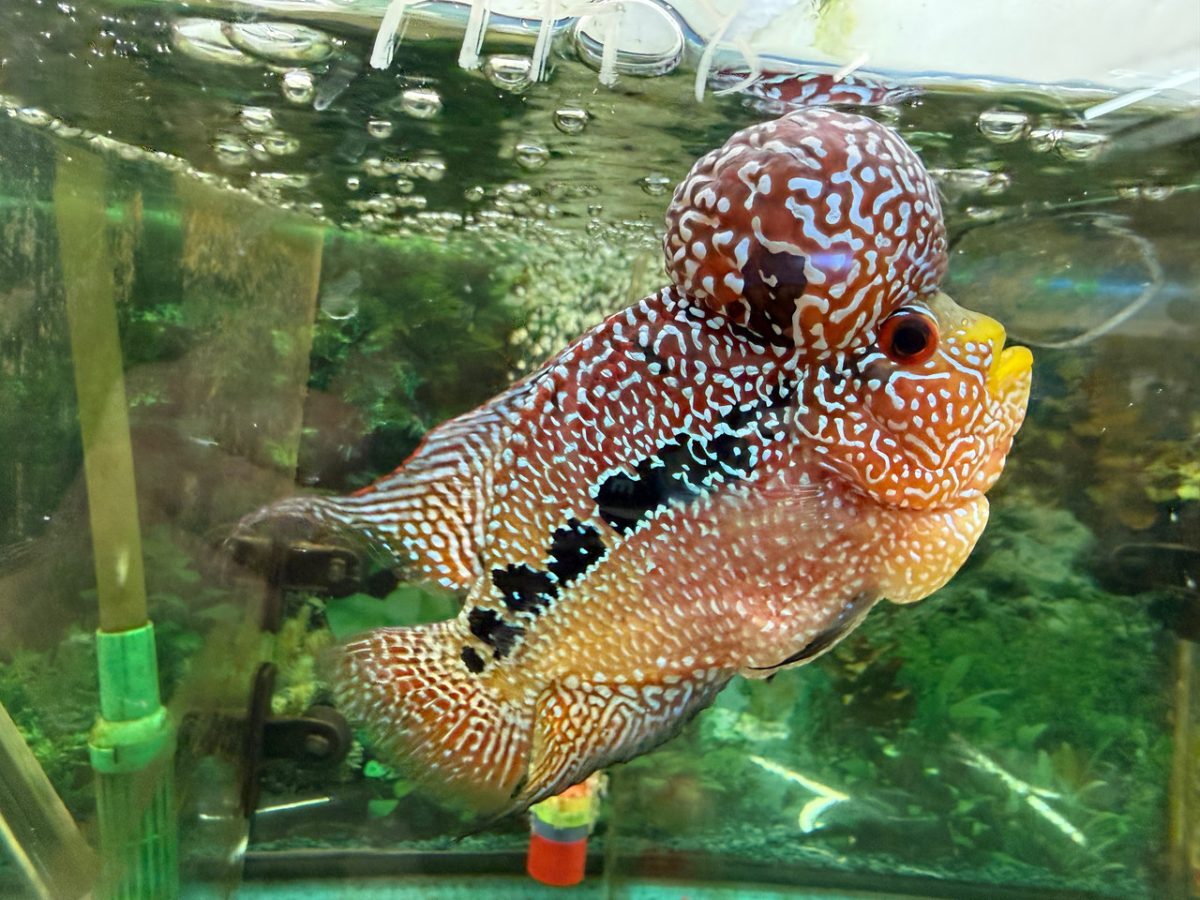
When buying, ask to see the fish under neutral light, ask what it has been eating, and compare it with its tankmates rather than a photo. Pet Zone keeps SRD ZZ flowerhorns in our San Diego store and ships them through flowerhorn.co. For what separates a pet-grade fish from a show fish, see grading.
Questions about Red Dragon and SRD flowerhorns
What is the difference between Red Dragon and Super Red Dragon?
Super Red Dragon is a higher color grade of Red Dragon, not a different cross. An SRD has deeper red that covers more of the body, commonly more than half its length.
Why is my SRD flowerhorn losing color?
The usual causes are settling into a new tank, stress, water quality, a dark substrate or a switch away from a color-rich diet. Young fish also go through natural color changes that can last months.
Does color-enhancing food work for flowerhorns?
Foods with carotenoids like astaxanthin support red color, because fish cannot make these pigments themselves. They can only bring out what the fish’s genes allow, and more is not always better.
At what size does an SRD flowerhorn get its red?
Red builds through the juvenile months. Good SRD fish often show strong red and pearling by about 2.5 to 3.5 inches, and color keeps developing for months after that.
Sources
- Is KML the same as SRD?, MonsterFishKeepers
- Carotenoids and pigmentation in ornamental fish, Journal of Aquaculture & Marine Biology
- Effects of dietary canthaxanthin on growth and body colour of blood parrot cichlid, Aquaculture International
- SRD Super Red Dragon flowerhorn fry, Pet Zone Tropical Fish
- Flowerhorn color is gone, MonsterFishKeepers
- Masculinization of flowerhorn by immersion in androgens, Science, Engineering and Health Studies