Strains
Thai Silk and Titanium flowerhorns
The flowerhorn that trades red for metal. A good Thai Silk looks like it was cast in silver and polished blue, and it wins people over with color rather than head size.
What a Thai Silk is
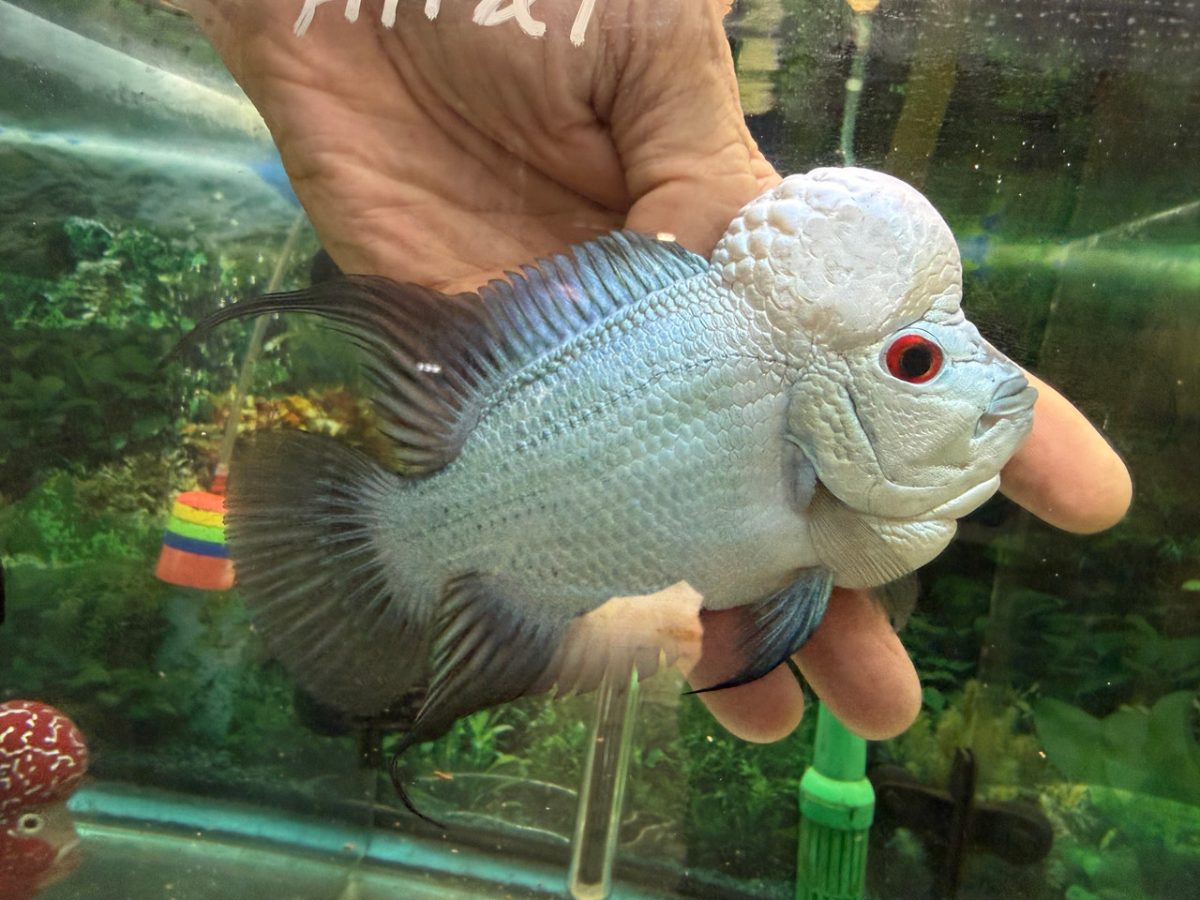
Most flowerhorn strains are judged on red: how deep it is, how far it runs, how it sits under the pearls. The Thai Silk goes the other way. Its whole body is covered in a metallic finish that ranges from bright white-silver to icy powder blue, sometimes with a violet or turquoise cast under strong light. Customers who walk past a row of red flowerhorns in our Mid-City store usually stop at the silver one.
You will see the same family sold under several names. Titanium and Blue Diamond are the common alternatives, and most sellers, including us, use all three for the same type of fish. There is no breed registry behind any of these names, so treat them as a description of the look rather than a guarantee of a specific bloodline.
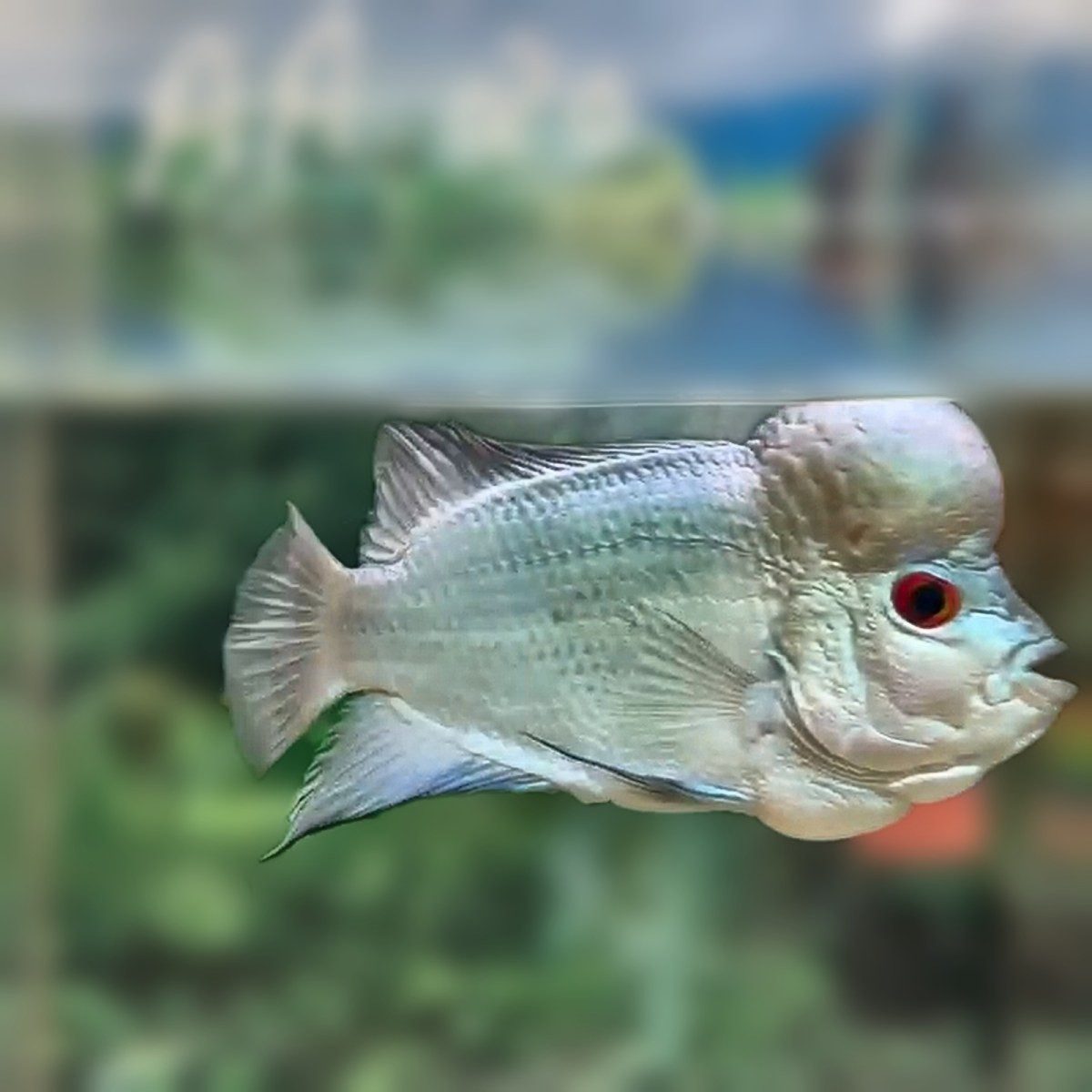
As our strains table on the breeding page puts it, the Thai Silk is associated with Thailand, carries a smaller kok than Kamfa, and is valued for its unusual color rather than head size. That is a fair one-line summary. The rest of this page is the detail behind it.
Where the strain came from (as far as anyone knows)
The name tells you the part people agree on: these fish were developed and popularized by breeders in Thailand. Beyond that, the history is hobby lore, and it is thin.
Nobody has published a breeding record, and the theories you will read online do not agree with each other:
- A pearl-line morph. Many keepers argue the metallic coat is an extreme version of the heavy pearling in Zhen Zhu lines, so a Thai Silk is essentially a ZZ-type fish whose pearls have spread into a solid sheet.
- A recessive metallic trait. Others point out that full-body metallic color behaves like the “electric blue” and platinum traits seen in other cichlids, and suspect a recessive gene was concentrated by line breeding.
- Extra blue-fish ancestry. Some breeders speculate about added Texas-type or Vieja blood, and forum discussions have floated blue-pearled cichlids as contributors. None of this is confirmed.
The practical takeaway: body shape varies a lot within the strain. Some Thai Silks have the longer, ZZ-style build; others show a squarer, Kamfa-style body, and those usually command more. If you want to know how the base lines differ, see our guides to Zhen Zhu and Kamfa.
How the silk develops with age
The metallic look is not a pigment in the way red is. It is usually explained as a dense, even coat of reflective pearling (sometimes called armor pearling) laid over whatever base color the fish carries underneath, rather than the separate white spangles you see on a ZZ. That one fact explains most of what surprises new owners.
| Fry, 1–2 in (2.5–5 cm) | Often a plain grey or silvery fish with a hint of blue shimmer and faint dark markings. Hard to grade. |
|---|---|
| Juvenile, 3–5 in (8–13 cm) | The metallic finish thickens and spreads. Blue tones usually become more obvious, and dark markings tend to fade under the silk. |
| Subadult to adult | A good fish holds even, solid coverage. Some fish instead thin out in patches, and a red, orange or yellow base shows through. |
| Kok | Usually starts in the same 6 to 12 month window as other flowerhorns, but stays smaller and firmer on most silks. |
Keepers commonly report that Thai Silks grow more slowly than red strains, so a young silk can look undersized next to a ZZ of the same age. That is normal for the type, not necessarily a sign of a problem.
The color that shows through when a silk “opens up” comes from its genetics. Some owners love the two-tone result; others are disappointed. It is part of the gamble described on our breeding page: color keeps changing well after you bring a fish home.
What to expect from the kok
If a big head is the main reason you want a flowerhorn, a Thai Silk is probably not your fish. Most silks develop a modest kok that is firm rather than balloon-like, closer to the hard head you see in ZZ lines than the tall water head of a show Kamfa. On the silver fish the kok is also pale, so it does not stand out the way a red kok does.
Kok size in any flowerhorn is set first by genetics, then helped along by warm, clean water, space and a good diet. A few silks with Kamfa-type bodies do put on an impressive head, and they are priced accordingly. For the full picture on what drives kok growth and what doesn’t, see our kok growth guide.
Fish that get confused with Thai Silks
Silver, white and pale blue cichlids are not rare, and sellers are not always careful with names. These are the mix-ups we see most:
Other flowerhorns
- Heavily pearled ZZ or Kamfa fish: lots of white spangles, but you can see a red or tan body between the pearls. A silk looks like a continuous sheet.
- Faded or stressed fish: any flowerhorn can wash out to a pale grey when stressed or sick. That pallor is flat, not metallic, and the fish usually acts off.
- Golden Base juveniles mid-fade: patchy light areas on a dark fish can read as silver in store lighting. See Golden Base and faders.
Other hybrids
- White or snow-white blood parrots: pale, but with the round parrot body and small mouth. Compare them in our flowerhorn vs blood parrot guide.
- Blue-pearled Texas-type hybrids: blue spangles on a darker body, often with a visible pattern of black spots.
- Dyed fish: parrot cichlids in particular are sometimes dyed, and an unusually flat pastel blue should raise questions. Real silk shifts with angle and light.
The simplest test is to watch the fish move under ordinary light. Metallic silk flashes and changes tone as the fish turns. Pale pigment, stress color and dye all look about the same from every angle.
Care notes specific to silks
A Thai Silk needs the same basics as any flowerhorn: at least 75 gallons for an adult, a single-fish tank, strong filtration, 80–86°F (27–30°C) and regular large water changes. Our flowerhorn care guide covers the full setup. A few points matter more with this strain:
- Keep the water stable and warm. Silks have a reputation among keepers as one of the more sensitive flowerhorn types. Owners often describe digestive trouble and sluggishness when temperatures dip or water quality slips. Keeping them toward the warmer end of the range is a common recommendation.
- Quarantine new fish. Some experienced keepers report that silks handle parasites less well than hardier strains. A few weeks in a separate tank before joining a display system is cheap insurance. See common flowerhorn diseases.
- Think about color foods. Heavy astaxanthin “color enhancing” diets are designed to push red and yellow. On a silk, many breeders prefer a quality staple pellet with some spirulina content, and use strong red-boosting foods sparingly so the base color underneath is not pushed through the metallic coat.
- Watch the tank background. A dark background or substrate makes silver and blue read more strongly, while a bright white tank can make a silk look washed out.
For feeding amounts and schedules by age, see our feeding guide. If you want to see silks in person or have one shipped, our current fish are at flowerhorn.co.
Questions about Thai Silk flowerhorns
Is a Titanium flowerhorn the same as a Thai Silk?
In practice, yes. Titanium, Thai Silk and Blue Diamond are trade names most sellers use for the same metallic silver-blue flowerhorn family, and there is no registry that separates them.
Why is my Thai Silk turning red or orange?
The silver-blue finish is a coat of pearling over a base color. As some silks mature, the coat thins in places and the red, orange or yellow base shows through, which is genetic and not usually a health issue.
Do Thai Silk flowerhorns get a big kok?
Most develop a smaller, firmer kok than Kamfa or Zhen Zhu fish. Silks with a square, Kamfa-type body can grow a larger head, but the strain is prized mainly for color.
Are Thai Silks harder to keep than other flowerhorns?
They need the same setup as any flowerhorn, but many keepers find them less forgiving of cool or dirty water. Stable warm temperatures, frequent water changes and quarantine for new fish go a long way.
How big do Thai Silk flowerhorns get?
Adults can reach about 12 inches (30 cm), and keepers often report slower growth than red strains. Plan on the same tank size as any adult flowerhorn.
Sources
- Grading: Thai Silk, Vincenzo’s Aquatics
- How to make Thai silk (titanium) flowerhorn?, MonsterFishKeepers forum
- Thai silk/Titanium health tip, MonsterFishKeepers forum
- Flowerhorn Types Guide, 4848 One Shop
- Thai Silk Flowerhorn Fry, Pet Zone Tropical Fish