Hybrid cichlids
Flowerhorn vs blood parrot
They are related, they are both orange-red hybrids, and they are the two hybrids buyers most often weigh against each other. They could hardly be more different to live with.
Two hybrids, one family tree
The blood parrot came first, bred in Taiwan in the 1980s. A few years later Malaysian breeders used blood parrots, along with red devils, trimacs and other Central American cichlids, to create the flowerhorn. So the two fish are cousins, and in a store tank of juveniles they can even look alike: small, round-ish and orange.
Grown up, they are different animals. One is a 7-inch community fish with a mouth that barely closes. The other is a foot-long, heavy-jawed fish that wants a tank to itself and treats its keeper as the most interesting thing in the room. Here is how they compare.
Side by side
| Flowerhorn | Blood parrot | |
|---|---|---|
| Origin | Malaysia, mid to late 1990s | Taiwan, commonly dated to about 1986 |
| Commonly cited parents | Red devil, trimac and blood parrot, with others by strain | Midas and redhead cichlid most often; severum and red devil also claimed |
| Adult size | About 10 to 16 in (25 to 40 cm); short-body types smaller | About 6 to 8 in (15 to 20 cm) |
| Temperament | Highly aggressive and territorial toward other fish | Territorial but mild; limited bite |
| Tank size | 75 gal (284 L) or more for one adult is a common recommendation | 30 gal (114 L) for one; 55 gal (208 L) for two or three |
| Tank mates | Best kept alone | Other parrots and peaceful fish of similar size |
| Lifespan | Commonly 10 to 12 years; short-body types often less | Often cited as 10 to 15 years |
| Mouth | Normal, powerful jaws; bites hard | Small triangular mouth that cannot fully close |
| Head | Kok (nuchal hump), often large | No kok; often a dip above the eyes |
| Cost range | Affordable pet grade to very expensive show grade | Inexpensive to moderate; premium types cost more |
| Interaction | Very high: greets, follows, hand-feeds, “water dog” | Moderate: learns its keeper and begs, shy when young |
| Male fertility | Many males sterile | Males generally infertile |
The ranges are typical, not guaranteed. Both are hybrids, and individual fish, strains and grades vary.
Size, tank and cost
This is the difference that decides most purchases. A flowerhorn sold at 2 inches can put on several inches in its first year and keep growing, and an adult produces a lot of waste. For one adult flowerhorn, most keepers recommend 75 gallons as a floor and many go to 90 or 125 gallons (340 to 473 L), with strong filtration, a heavy lid and a sturdy stand. Full details are in flowerhorn tank setup.
A single blood parrot is comfortable in 30 gallons, and a small group lives well in a 55 or 75. Filtration still needs to be generous, because parrots are enthusiastic eaters, but the whole setup costs a fraction of a big flowerhorn tank.
Water needs overlap. Both want warm, clean water: flowerhorns do best around 80 to 86°F (27 to 30°C) at pH 7.0 to 8.0, while blood parrots are commonly kept a little cooler, around 76 to 82°F (24 to 28°C), near neutral pH. Both need weekly water changes. See water and temperature.
Blood parrots are among the more affordable large hybrids in most stores, with premium types such as King Kong, Yuan Bao and platinum parrots costing more. Flowerhorns cover a much wider range. A young pet-grade Golden Base or Red Dragon is within reach of most budgets, while a top-grade Kamfa or SRD with a proven head and pearling can cost many times more, and show fish in Asia have sold for extraordinary sums. Remember the tank: for a flowerhorn, the aquarium often costs more than the fish.
Current flowerhorn pricing is covered in what flowerhorns cost.
Temperament and tank mates
A flowerhorn is one of the most aggressive fish in the freshwater hobby. Most will attack tank mates, mates included, and a fish that tolerated company as a juvenile often turns on it later. The dependable approach is one flowerhorn per tank, with a divider if you keep more. Our tank mates guide covers the rare exceptions and why most fail.
A blood parrot is territorial too, and will chase fish away from its cave, but its small mouth means it rarely does real damage. Parrots do well in groups and alongside severums, silver dollars, larger tetras, rainbowfish and plecos. Their main risk in a community is losing the race for food.
Mouth, feeding and health
Flowerhorns have normal cichlid jaws and eat almost anything: large pellets, shrimp, krill and insects. Feeding is mostly about restraint, since overfed flowerhorns foul the water and bloat. See feeding.
Blood parrots have a small mouth that cannot close fully. They suck food in rather than biting, so they need small, soft or floating pellets and a bit of attention to make sure they are getting their share. Their compressed bodies can also bring swim bladder trouble, which is a concern the parrot shares with short-body flowerhorns.
Both are hardy when the water is clean. The flowerhorn’s best-known problem is hole-in-head disease, which is closely tied to water quality and diet; both fish get ich, fin rot and stress-related illness in poor conditions. More in diseases.
Personality and interaction
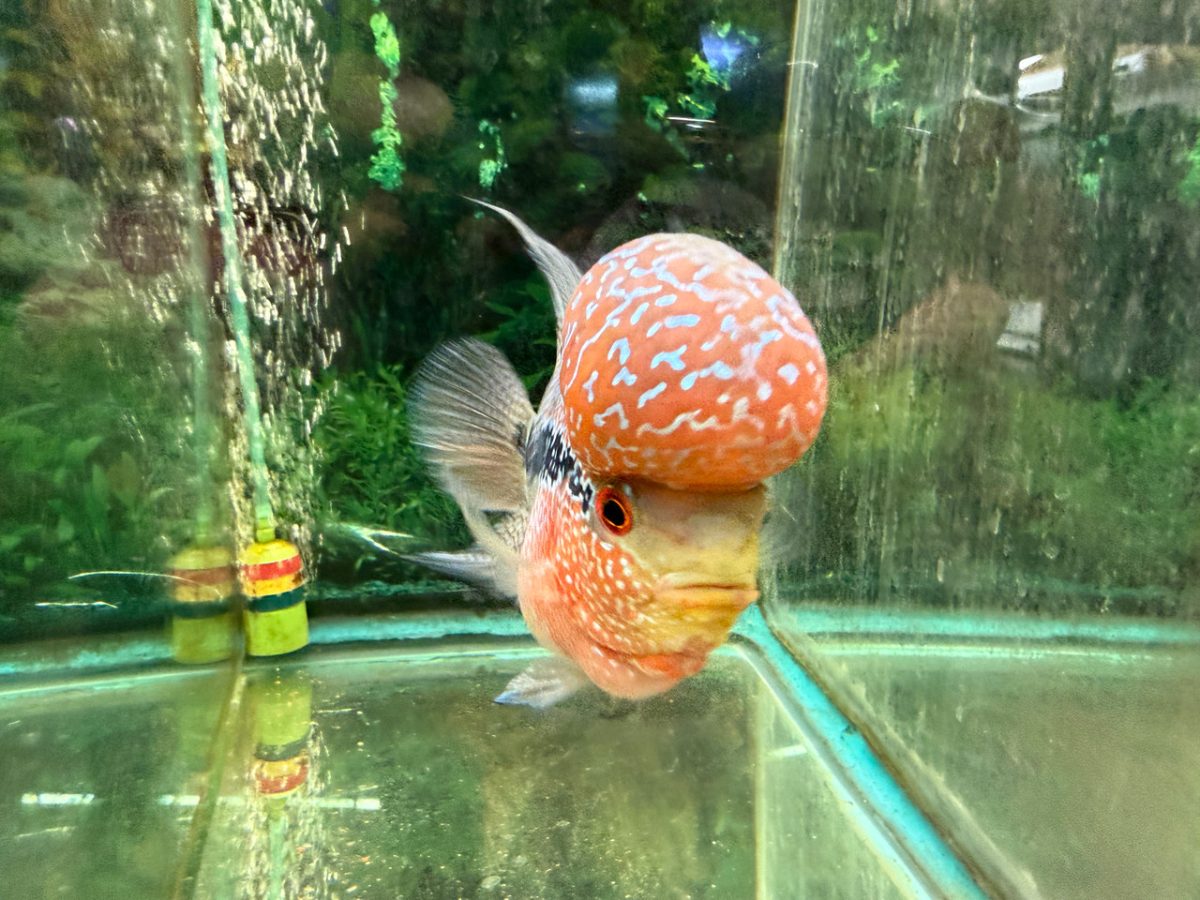
If you want a fish that acts like a pet, the flowerhorn is hard to beat. A settled flowerhorn rushes to greet its keeper, follows a finger along the glass, pushes toys around and often takes food from the hand. Keepers call it a water dog, and the reasons are on our flowerhorn as a pet page.
Blood parrots are more reserved, especially when young, and spend a lot of time around their caves. Once comfortable they recognize their keeper, beg at feeding time and can be quite comical, and a group of parrots interacting with each other is its own kind of entertainment.
Who should choose which
Choose a flowerhorn if
- You want one fish with a big personality that interacts with you daily
- You have room for a 75-gallon or larger tank
- You are happy keeping it alone
- You are drawn to the kok, pearling and the world of strains and grading
- You value the fish’s traditional association with luck
Choose a blood parrot if
- You want a community tank with several fish
- You have a 30 to 55 gallon tank
- You prefer a gentler fish that won’t bite hands or tank mates
- You want a colorful cichlid on a smaller budget
- You are newer to cichlids
Somewhere in between? The Kirin parrot brings flowerhorn color to a parrot-sized fish, and the King Kong parrot is a bigger, bolder parrot. You can browse flowerhorns and parrots from Pet Zone at flowerhorn.co, and read about all of these crosses in hybrid cichlids explained.
Questions about flowerhorns and blood parrots
Is a flowerhorn related to a blood parrot?
Yes. Blood parrots were among the fish Malaysian breeders crossed with red devils and trimacs in the 1990s to create the flowerhorn.
Can a flowerhorn and a blood parrot live together?
It is not recommended. Flowerhorns are much larger and more aggressive, and a blood parrot’s small mouth leaves it unable to defend itself or compete for food.
Which is better for beginners, a flowerhorn or a blood parrot?
A blood parrot is easier: it needs a smaller tank, tolerates tank mates and forgives mistakes. A flowerhorn is manageable for a committed beginner who can provide a large tank and keep it alone.
Can a flowerhorn and a blood parrot breed?
They can. A female blood parrot is often fertile, and crosses with male flowerhorns are sold as Kirin parrots.
Sources
- Flowerhorn cichlid, Wikipedia
- Blood parrot cichlid, Wikipedia
- Flowerhorn cichlid care, FishLore
- Care guide for blood parrot cichlids, Aquarium Co-op
- Ultimate guide to flowerhorn cichlids, Pet Zone Tropical Fish